
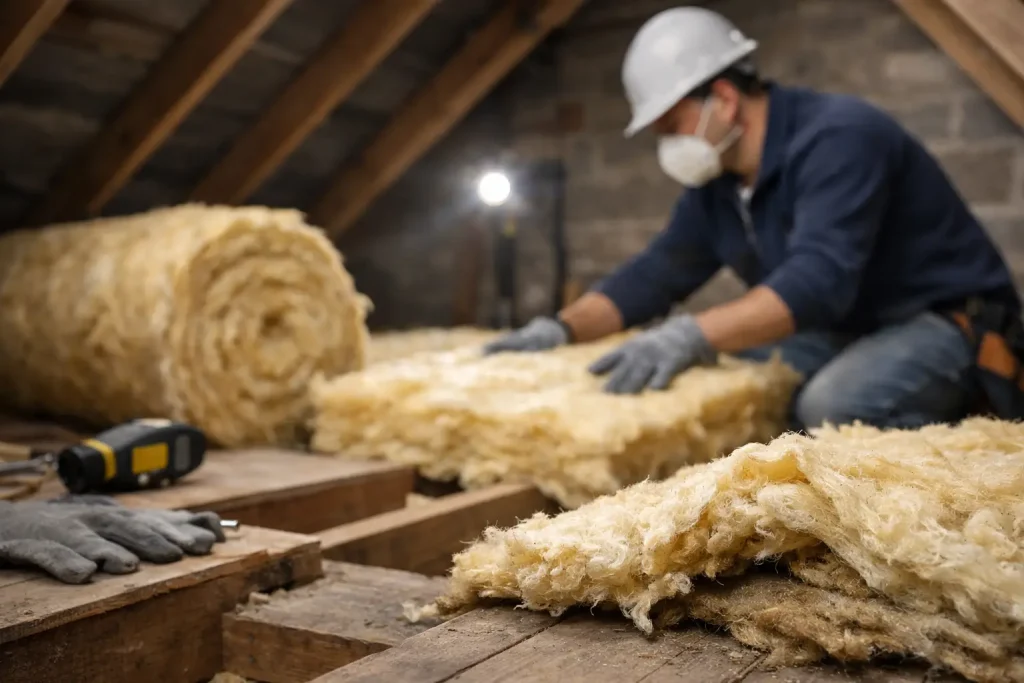
If your loft is dusty, cramped, or full of old insulation that has clearly seen better days, it is fair to ask when should loft insulation be replaced. The short answer is not simply every few years. Good insulation can last a long time, but age on its own is not the real issue. What matters is whether it is still doing its job properly, safely, and without causing problems elsewhere in the home.
For most homeowners, the question comes up after noticing colder rooms, higher heating bills, damp smells, or a loft that is difficult to use for storage. In many cases, the insulation does not need a full replacement. In others, replacing it is the smartest option because topping it up would only cover up a deeper problem.
When should loft insulation be replaced rather than topped up?
Loft insulation should usually be replaced when it has become damaged, contaminated, compacted, or no longer performs to a useful standard. If it is simply thinner than current recommendations but otherwise clean and dry, a professional top-up may be enough. The difference matters, because replacing insulation is a bigger job, but sometimes it is the only way to restore proper thermal performance.
One of the clearest signs is moisture. Insulation that has become damp from condensation, a roof leak, or long-term poor ventilation will not work as it should. Wet insulation loses effectiveness, can encourage mould, and may create musty odours that spread into the house. If the material has dried out after a minor issue, it may still be usable, but if there is staining, clumping, or signs of fungal growth, replacement is often the safer route.
Pest activity is another common reason. If rodents have nested in the loft, the insulation may be soiled and disturbed far beyond what is sensible to keep. Even if the loft looks passable at first glance, contamination can be spread over a surprisingly wide area. In that situation, replacing affected sections – or sometimes the whole lot – gives you a cleaner and more reliable result.
Compression is also a problem, especially in lofts where boards have been laid directly onto the insulation. Once insulation is squashed, it traps less air, and trapped air is what helps slow heat loss. This is why a boarded loft needs to be handled properly. In newer homes in particular, raised systems are important because they protect the insulation depth and avoid creating storage space at the expense of energy efficiency.
How long does loft insulation last?
Loft insulation can last 20 to 40 years, and sometimes longer, but that range can be misleading. Lifespan depends on the material, the condition of the loft, and how well the insulation was installed in the first place. Mineral wool, for example, does not usually expire on a fixed date. If it stays dry, clean, and undisturbed, it can keep performing for decades.
That said, older insulation often falls short of modern expectations even if it has not technically failed. Many houses still have a thin layer installed years ago, when standards were lower and fuel costs were very different. It may still be present, but that does not mean it is enough. If the depth is well below current recommendations, your home could be losing heat unnecessarily.
This is where a proper assessment helps. A loft can have insulation that is old but serviceable, old and inadequate, or old and worth removing altogether. Those are three different situations, and they should not be treated the same way.
Signs your loft insulation may need replacing
Some warning signs are obvious, while others are easy to miss until the heating bills climb or the loft becomes unpleasant to access. If the insulation looks patchy, flattened, damp, dirty, or uneven, it is worth having it checked. Cold spots in upstairs rooms can also point to areas where insulation is missing or no longer working properly.
A persistent musty smell from the loft is another clue. This can suggest moisture build-up, poor airflow, or contamination within the insulation itself. Discolouration around joists or insulation layers may also indicate past water ingress. Even if the roof problem has been sorted, the insulation may still have been compromised.
Another issue is draughts around the loft hatch or noticeable heat escaping through the ceiling. Some heat loss is normal, but if your loft feels far warmer than expected in winter while the rooms below cool quickly, your insulation may not be giving you much benefit.
Older installations can also make it difficult to use the loft safely. If insulation is laid loosely between joists with no proper raised boarding above it, storage becomes awkward and the material can easily be disturbed or crushed. In that case, replacing or upgrading the insulation as part of a better overall loft setup often makes more sense than trying to work around it.
When old insulation can stay in place
Not every loft with ageing insulation needs a full strip-out. If the existing insulation is dry, clean, and still in decent condition, it can often remain in place with an additional layer installed above or alongside it. This is often the most cost-effective option and avoids unnecessary waste.
The key is whether the existing base is sound. Topping up over damaged insulation is rarely a good investment. Topping up over clean but insufficient insulation, on the other hand, can make a noticeable difference to comfort and energy use.
A professional survey should also consider access, ventilation, and storage plans. There is little benefit in adding extra insulation if it will just be compressed later. The loft needs to work as a complete system, not as a set of separate fixes.
What happens if you leave failing insulation in place?
Poor loft insulation does more than make the house feel chilly. It can lead to higher heating costs, uneven room temperatures, and a loft space that is unpleasant or impractical to use. In some homes, it can also contribute to moisture problems, especially if insulation and ventilation are out of balance.
There is also the issue of false economy. Homeowners sometimes keep old insulation because it is still technically there, but if it is damp, compacted, or contaminated, it may be offering very little value. You still have the mess, the inconvenience, and the lost loft space, but without the thermal benefit you should be getting.
For families trying to make better use of the home they already have, that matters. A loft should not be an afterthought. It should be safe to access, properly insulated, and suitable for sensible storage where appropriate.
Should loft insulation be replaced before boarding?
In many cases, yes. If you are planning to board the loft, it is sensible to assess the insulation first. Boarding over poor-quality insulation only locks in the problem and can make future remedial work more awkward.
This is especially important where older boards have been fitted directly onto joists, compressing the insulation underneath. That setup often reduces thermal performance and leaves the loft with neither proper insulation nor particularly practical storage. A raised boarding system above the insulation is usually the better long-term answer.
In newer properties, care is needed to protect the structure and preserve warranty requirements. That is one reason specialist loft companies use approved raised support systems rather than simply laying boards across the top. Done properly, you get usable storage space without flattening the insulation that helps keep the home efficient.
A professional assessment is worth more than a guess
The difficulty with deciding when should loft insulation be replaced is that many loft problems look similar from the hatch. Dust, age, and uneven coverage can hide more serious issues underneath. What seems like a quick top-up job may actually involve trapped moisture, historic leaks, compressed layers, or poor ventilation.
A proper inspection gives you a clearer answer. It should look at insulation depth, condition, signs of damp, airflow, access, and whether the loft is being used or planned for storage. That way, the recommendation fits the property rather than following a one-size-fits-all rule.
At Loft Accessories, this is exactly why we put so much value on straightforward surveys and clear written quotes. Homeowners do not need guesswork or pressure. They need honest advice on whether the existing insulation can stay, whether it should be upgraded, or whether replacement is the better investment.
If your loft insulation is dry, clean, and still performing, there may be no reason to remove it. But if it is tired, damaged, or getting in the way of a safer and more efficient loft space, replacing it can make the whole house feel warmer, neater, and easier to live with. Sometimes the best time to act is simply when your loft has started telling you it is no longer working as it should.