
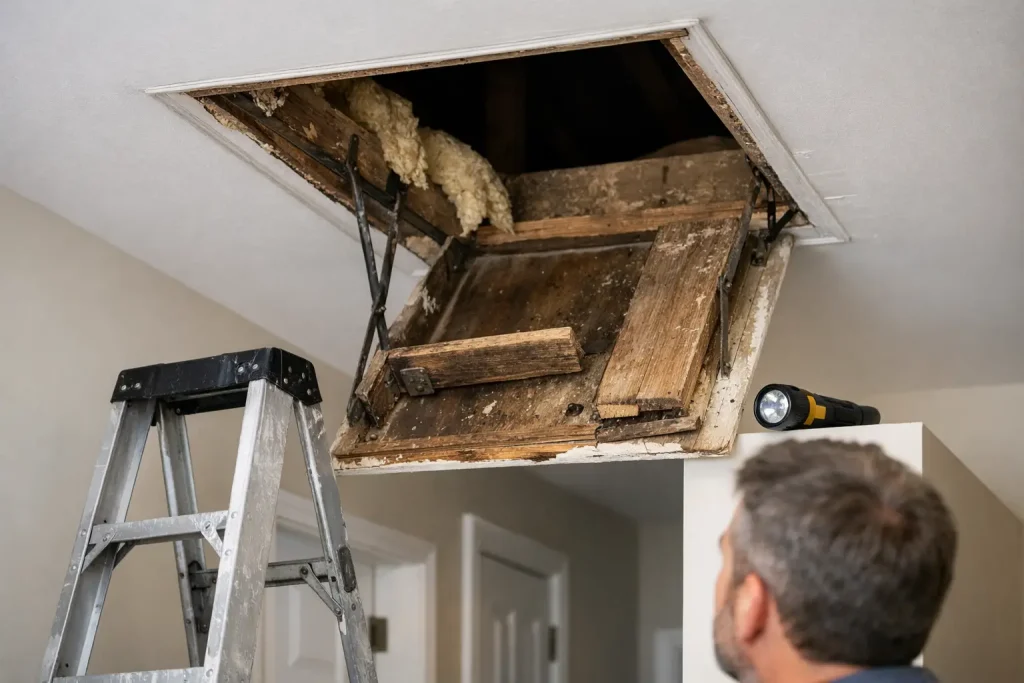
If you have to drag a heavy hatch aside, balance on a chair or hesitate before climbing into the loft, it is time to look closely at the top signs your loft access needs replacing. A loft should be useful storage space, not an awkward or unsafe part of the house that you avoid until something has to be retrieved.
For many homes, the issue is not the loft itself. It is the hatch, ladder or surrounding structure that makes access difficult. Replacing tired access can make everyday storage easier, improve safety and provide an opportunity to address heat loss around an often-overlooked opening in the ceiling.
Top signs your loft access needs replacing
The loft hatch is damaged, warped or difficult to operate
A hatch that sticks, drops suddenly, will not sit flush or needs force to open has passed the point of being merely inconvenient. Timber hatches can warp over time, while hinges, catches and handles can loosen through repeated use. Cracks, chipped edges and staining may also point to age, moisture issues or an opening that is no longer properly protected.
Pay attention to how the hatch closes. If it leaves visible gaps, rattles when doors or windows are opened, or feels noticeably cold around the edges, warm air may be escaping into the loft. This can make nearby rooms less comfortable and add to heating costs, particularly through winter.
A well-fitted replacement hatch should open and close smoothly, sit neatly within its frame and be appropriately insulated. The best option depends on the ceiling construction, available headroom and how often the loft is used, but the goal is simple: secure access without unnecessary draughts.
Your ladder feels unstable or difficult to use
An unsafe ladder is one of the clearest reasons to arrange a replacement. Warning signs include movement at the fixing points, bent sections, worn treads, loose handrails or a ladder that does not lock firmly into position. A ladder may also be the wrong length or angle for the opening, forcing you to stretch, stoop or step awkwardly when entering the loft.
This matters most when you are carrying boxes, seasonal decorations or luggage. Even a lightweight item can affect your balance when your hands are occupied. A properly fitted loft ladder creates a stable route up and down, with suitable support and a dependable locking mechanism.
There are different ladder styles, and the right choice is not always the biggest or most elaborate one. Available floor space below the hatch, loft height, clearance above the opening and frequency of use all need consideration. An honest survey should identify a solution that is practical for the home, rather than simply fitting the first ladder that will physically fit.
The opening is too small for safe, useful access
Older hatches are often surprisingly narrow. If you have to turn sideways to get through, cannot safely pass up normal storage boxes, or regularly knock your head on the frame, the opening may no longer meet your needs.
A larger opening can make a substantial difference to how usable the loft feels. It gives better access for stored items and can make climbing in and out less cramped. However, enlarging a hatch must be assessed properly. Ceiling joists, electrics, pipework and the structure around the opening all need to be considered before any work begins.
The aim is not to make the biggest opening possible. It is to provide an access point that feels comfortable and safe while respecting the construction of the property. This is where a loft specialist’s experience is particularly valuable.
You rely on a chair or temporary step to reach the ladder
Having to use a chair, stool or step to reach loft access is a common household workaround, but it is not a safe long-term arrangement. It creates an extra transition point where slips and falls can happen, especially on hard flooring or when someone is trying to carry items.
The ladder should be accessible from floor level and designed to deploy safely. If the hatch is too high, the pull mechanism is unreliable, or there is no sensible way to open it without overreaching, the access setup needs attention. Children and older relatives are not the only people at risk – anyone can lose their footing when working in a confined space above a stairwell or landing.
There are draughts, condensation or heat loss around the hatch
Many homeowners focus on loft insulation but overlook the hatch beneath it. A poorly insulated or badly fitting hatch can form a gap in your home’s thermal envelope. You may notice a cold patch beneath the loft opening, a draught around the frame or condensation in the colder months.
Condensation can be a warning that warm, moisture-laden air from the house is reaching the colder loft. Left unresolved, this can contribute to damp conditions and affect items kept in storage. While ventilation and insulation levels should also be considered, a replacement hatch with good seals and insulation can be an important part of the solution.
This is especially worthwhile when improving loft insulation or boarding at the same time. Planning the access, insulation and storage platform together helps prevent one improvement from compromising another. In newer homes, raised boarding supported by NHBC approved loft legs can preserve the depth of insulation beneath the storage area, helping to protect both thermal performance and the property’s warranty requirements.
The frame, ceiling or fittings show signs of strain
A crack in the surrounding ceiling, a frame pulling away from the plasterboard, or fixings that repeatedly work loose should never be ignored. Some marks may be cosmetic, but others can indicate that the existing hatch or ladder has not been installed with suitable support, or that it is being asked to carry more load than intended.
Do not assume a new catch or a fresh coat of paint will resolve the underlying problem. The condition of the opening and its surrounding structure should be checked before replacement work is specified. A professional assessment can separate straightforward wear from issues that need a more careful approach.
When replacement is worth considering before a problem develops
You do not need to wait for a ladder to fail or a hatch to become unusable. Replacement is often sensible when a household’s needs have changed. Growing families tend to need more organised storage, while long-term homeowners may want easier access to suit the way they use their home now.
It can also be a good time to update access when planning new insulation or loft boarding. Completing the work as one coordinated project avoids disturbing finished areas later and gives you a loft space that is easier to reach, safer to use and better protected against heat loss.
The trade-off is that not every old hatch needs immediate replacement. A simple, well-fitting hatch with an intact frame and safe ladder may only require minor adjustment. But where access is awkward, cold, damaged or unstable, delaying the decision can mean continued inconvenience and avoidable risk.
What a proper loft access assessment should cover
Before work is recommended, the survey should look beyond the hatch itself. A reliable assessment considers the opening size, ceiling construction, available room below, headroom in the loft, ladder position, insulation depth and the condition of the surrounding area. It should also consider what you actually want to store and how frequently you will use the space.
You should receive clear advice about the suitable options, what the installation involves and the expected cost before work begins. Written quotes and fully insured workmanship provide useful reassurance, particularly where access changes need to fit neatly into an occupied family home.
For homeowners across Milton Keynes and nearby areas, Loft Accessories can assess the whole loft setup and explain the sensible options in plain English. The right replacement should feel like a straightforward improvement: safer underfoot, easier to operate and warmer around the ceiling below.
A loft is most useful when you can reach it confidently. If using yours has become a task you put off, arranging a professional survey is a sensible first step towards storage that works properly for your home.