
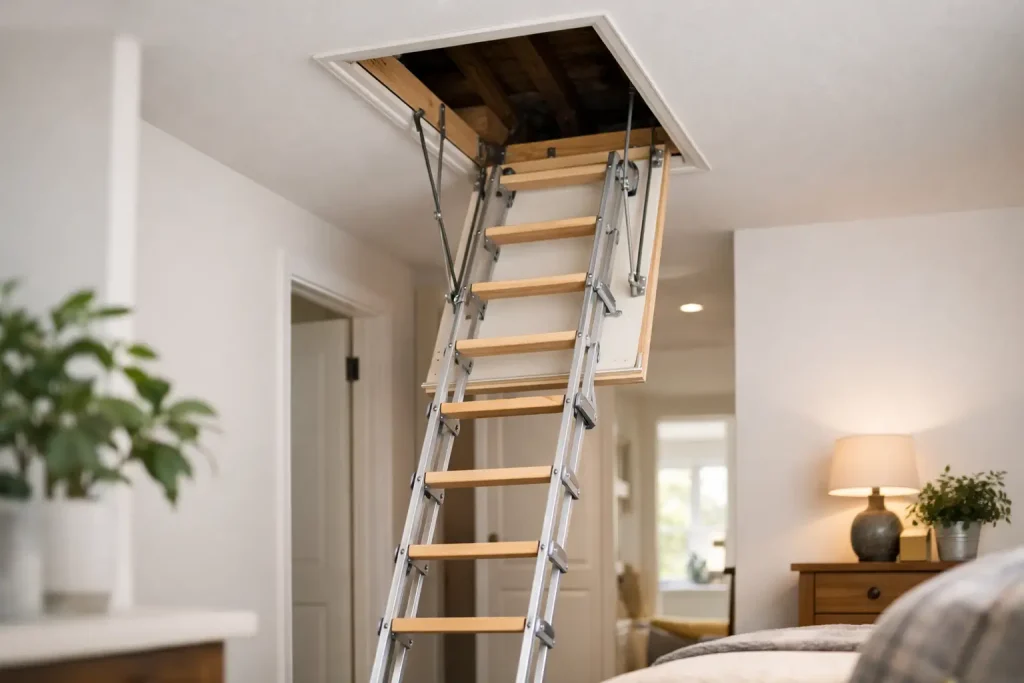
The problem with most lofts is not the space itself. It is the awkward, unreliable way you have to reach it. If you are balancing on a stepladder, stretching for a hatch, or putting off using the loft altogether, it quickly becomes clear how loft ladders improve access in a way that changes the room below as much as the space above.
A loft should be practical. It should give you somewhere safe to store the things you need to keep but do not want underfoot every day. When access is poor, that space often goes to waste. Boxes stay piled in spare rooms, cupboards stay overfilled, and the loft becomes a place you avoid rather than use.
How loft ladders improve access in everyday life
The biggest change a loft ladder brings is simple – it turns occasional, awkward access into something regular and manageable. Instead of dragging out a separate ladder and hoping it sits securely, you have a fitted solution designed for the space. That means getting into the loft is faster, steadier and far less of a chore.
For busy households, that makes a real difference. Seasonal items, suitcases, children’s keepsakes, paperwork and decorations become much easier to store and retrieve. You are more likely to use the loft properly when the route up there feels safe and straightforward.
It is not only about convenience, either. Better access often changes how people think about their home. Once the loft feels usable, it becomes part of the house rather than a forgotten void above the ceiling.
Safety matters more than people think
Poor loft access is one of those household issues many people live with for years. They make do with an old stepladder, a wobble, and a bit of luck. The trouble is that carrying boxes while reaching overhead is never ideal, particularly in homes where the hatch opening is small or awkwardly placed.
A properly fitted loft ladder gives you a safer, more stable way to climb up and down. The angle is more controlled, the footing is more secure, and the ladder is made to work with the hatch rather than against it. That reduces the strain on your back, shoulders and knees, which matters just as much as preventing slips.
This is especially valuable for families and long-term homeowners who want a solution that will still feel practical years from now. What feels manageable today may not feel quite so easy in five or ten years. Good access is a long-term improvement, not just a short-term fix.
Safer access encourages proper storage habits
When getting into the loft is easier, people tend to store things more sensibly. Items can be placed with a bit more care rather than pushed into the nearest spot during a rushed trip up a temporary ladder. That helps avoid clutter near the hatch and makes the whole area simpler to use.
There is also less temptation to keep too much in bedrooms, under beds or in hall cupboards simply because the loft feels inconvenient. In that sense, better access supports a tidier house overall.
Loft ladders make storage space genuinely usable
There is a difference between having loft space and being able to use it well. Many homes technically have plenty of room overhead, but if access is awkward, the space does not perform as useful storage.
A fitted loft ladder helps bridge that gap. It gives you confidence to use the loft more often and more efficiently. If the hatch opens easily and the ladder is ready when you need it, storing away bulky but infrequently used items becomes much more realistic.
That can be particularly helpful in homes where every cupboard is already working hard. Growing families often need more storage without losing living space downstairs. A well-accessed loft can take pressure off bedrooms, landings and wardrobes, all without changing the footprint of the property.
Access works best when the rest of the loft is considered too
A loft ladder does its best work as part of a wider access setup. If the hatch is too small, poorly positioned or difficult to operate, that can still limit how usable the space feels. The same goes for lofts with inadequate boarding or compressed insulation.
That is why the best results usually come from looking at the whole picture. Safe access, suitable boarding and effective insulation all support each other. One without the others can leave the job only half done.
The right ladder depends on the home
Not every loft needs the same type of ladder. The right choice depends on the available space, the height from ceiling to loft floor, how often the loft is used, and who will be using it.
For some homes, a compact folding ladder is the sensible option. In others, a sliding or concertina design may suit the layout better. What matters is not choosing the fanciest model, but choosing one that works reliably for the property and the household.
There are trade-offs. A more compact ladder may suit tighter landings, but frequent users might prefer something that feels sturdier underfoot. A timber ladder can offer a solid feel, while aluminium options are often lighter and practical. It depends on how the loft is going to be used day to day.
This is where specialist advice really helps. A proper survey can identify what will fit, what will feel comfortable to use, and whether the hatch itself also needs attention.
How loft ladders improve access without wasting space
One concern many homeowners have is whether adding a loft ladder will make a hallway or landing feel cramped. In most cases, a fitted system actually makes the area more practical because it is stored neatly away when not in use.
That is a major improvement over relying on a separate ladder that has to be fetched from the garage, shed or understairs cupboard. A built-in solution keeps the process tidy and contained. Open the hatch, lower the ladder, use the loft, and close everything away again.
For homes where space downstairs is limited, that convenience matters just as much as the loft access itself. It keeps everyday life simpler.
Better access often leads to better energy decisions
Homeowners rarely start by thinking about insulation when they ask about loft access. Usually, they just want to stop wrestling with an awkward hatch. But once access improves, it becomes much easier to see the loft as part of the home’s overall efficiency.
If the loft is difficult to reach, insulation issues are easy to ignore. Once there is safe, regular access, it is more straightforward to inspect the space, maintain it properly and make sensible upgrades. In many cases, access improvements sit naturally alongside raised loft boarding, so insulation can perform properly without being squashed.
That matters in newer properties in particular, where using NHBC approved loft legs can help protect the insulation depth and preserve the intended performance of the loft floor. It is a practical detail, but an important one. Good access should not come at the cost of reduced thermal efficiency.
A professional finish makes the difference
Loft access is one of those jobs where the finish really shows. A poorly fitted hatch or ladder can leave draughts, awkward operation and a result that never feels quite right. A properly installed system should open cleanly, sit neatly and feel secure every time it is used.
For homeowners, that means looking beyond the ladder itself. Clear recommendations, honest written quotes, full insurance and tidy workmanship all matter. You want to know the advice suits your property, not a one-size-fits-all approach.
That is especially true if you plan to use the loft regularly. Reliable installation gives you confidence in the space and helps the whole improvement feel worthwhile from day one.
Why this small change has such a big impact
Loft ladders are not the most glamorous home improvement, but they are one of the most useful. They remove a daily frustration, make storage easier to manage and help you use space that already belongs to your home.
For many households, the real value is not only in safer climbing or quicker access. It is in the knock-on effect. Rooms downstairs feel less cluttered. Important items are easier to reach. The loft becomes an organised, practical part of the house instead of an awkward afterthought.
If you have been putting off using your loft because access feels inconvenient or unsafe, that hesitation is usually the clearest sign that the setup is not working as it should. A better route up there can make the whole home feel easier to live in, which is often exactly what a good home improvement should do.