
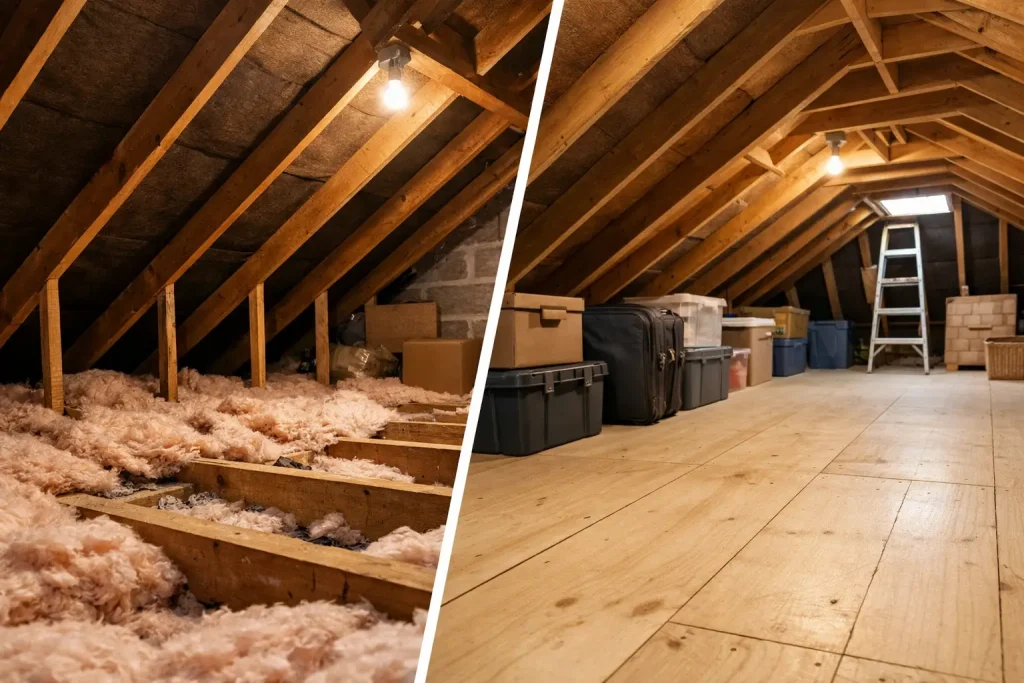
A lot of lofts look usable at first glance. There is floor area, there is head height, and there are plenty of things upstairs that need a proper home. Then you put a foot down in the wrong place, realise the insulation is in the way, and quickly see why loft boarding before and after can feel like two completely different parts of the same house.
For most homeowners, the biggest change is not cosmetic. It is practical. A boarded loft turns an awkward, underused area into somewhere you can access safely, store things properly, and keep organised without compromising the insulation that helps control heating bills.
Loft boarding before and after: the real difference
Before boarding, many lofts are a mix of exposed joists, deep insulation and limited safe footing. That often means boxes balanced in unsuitable places, belongings pushed into corners, and a space that is technically there but not genuinely useful. Even getting up into the loft can feel inconvenient if the hatch is awkward or the ladder is unreliable.
After professional loft boarding, the same loft becomes far easier to use. You have a stable raised platform for storage, a clearer layout and a proper route in and out. Instead of treating the loft like a place to avoid, homeowners tend to use it as an extension of the home – not as living space, but as sensible, accessible storage that frees up bedrooms, cupboards and landings.
That before-and-after difference matters because most households are not short of possessions. They are short of organised space. Seasonal decorations, suitcases, paperwork, baby items, keepsakes and occasional-use household goods all need somewhere dry, secure and easy to reach.
What a loft often looks like before boarding
In many homes, the loft is full of wasted potential. The insulation may sit above the joists, which is exactly where it should be for thermal performance, but that also makes direct boarding at joist level a poor solution. If boards are laid straight on top of the insulation, the insulation gets compressed and cannot do its job properly.
This is one of the most common misunderstandings. Homeowners see unused loft floor area and assume it only needs a few boards. In reality, a proper installation needs to account for insulation depth, load-bearing support and safe access. Otherwise, you can end up with storage that causes other problems.
Before boarding, there is also usually very little structure to how the space is used. Items get stored wherever there is room. Fragile things end up near the hatch. Heavier boxes might be placed where they should not be. Over time, lofts can become more cluttered precisely because they are harder to use well.
What changes after professional boarding
The most obvious improvement is a solid storage surface. Raised boarding creates a usable platform above the insulation, so the loft remains thermally efficient while becoming practical. That means you can store belongings with more confidence and move around with far less risk.
The second big change is access. When loft boarding is planned properly, it usually works best alongside a suitable loft ladder and hatch arrangement. There is little point creating better storage if getting into the loft remains awkward or unsafe. Good access changes how often the space is used and how manageable it feels.
The third change is peace of mind. A professionally boarded loft is not just tidier. It is a safer and more dependable part of the home. You know where to step, you know where things are kept, and you are less likely to disturb insulation or damage the ceiling below.
Loft boarding before and after insulation performance
This is where the right approach makes a real difference. The phrase loft boarding before and after often brings to mind storage improvements, but energy performance is just as important.
Older assumptions about lofts were simple: board the floor and fill the space. The problem is that modern insulation standards usually require deeper insulation than the joists alone can accommodate. Compressing that insulation reduces its effectiveness, which can contribute to heat loss and higher energy bills.
Raised systems avoid that issue by lifting the boards above the insulation layer. In newer properties, this is especially important. Using NHBC approved loft legs for suitable installations helps preserve the performance of the insulation and protects the validity of the NHBC warranty. That is not a minor detail. It is exactly the sort of thing that should be considered before any work begins.
So the before-and-after picture is not only about gaining storage. It is also about keeping the loft working properly as part of the home’s thermal envelope.
Safety is one of the biggest before-and-after gains
Many people only think about safety after a near miss. A slip from a joist, a wobble near the hatch, or the sudden realisation that there is nowhere secure to place your feet tends to focus the mind.
A properly boarded loft helps reduce those risks. It provides a defined area for storage and movement, rather than relying on guesswork. Combined with suitable access, it turns the loft into a space that can be used more confidently by the household.
That said, not every loft should be boarded wall to wall, and not every household needs the same amount of storage. A trustworthy specialist will assess the space, explain what is suitable and recommend a solution based on the property rather than applying a one-size-fits-all approach. Sometimes a partial boarding layout is the better choice, especially when balancing storage needs with layout, clearance and existing insulation.
The effect on day-to-day life
The practical benefit of loft boarding is often felt downstairs. Cupboards stop overflowing. Spare rooms become easier to keep tidy. Hallways and airing cupboards are no longer carrying the burden of storing everything that does not fit elsewhere.
Families often notice the difference quickly. Items that need to be kept but not used every day can be moved out of the main living space without being forgotten. That is especially helpful in homes where storage is tight and every room is expected to work hard.
There is also a psychological difference. A cluttered home can make everyday life feel more chaotic than it needs to be. When the loft becomes a proper storage area, the house often feels calmer and easier to manage.
Why the installation method matters
The gap between a good result and a disappointing one usually comes down to how the work is done. Loft boarding is not simply about laying boards. It is about creating usable storage without undermining insulation, access or safety.
That is why specialist knowledge matters. A dedicated loft company will look at joist levels, insulation depth, hatch suitability and the intended use of the space before recommending a system. They will also explain the trade-offs clearly. If a loft has limited height, for example, raising the boarding above insulation is still the right approach, but it may affect how much vertical storage room remains. Honest advice matters more than overpromising.
A good installation should also be neat and tidy. Homeowners want practical improvements, not disruption. Clear written quotes, insured work and a straightforward process all help make the experience feel as reliable as the finished result.
Is loft boarding worth it?
For many households, yes – but it depends on what you need the loft to do. If your main frustration is lack of accessible storage, the difference can be immediate. If your loft also needs insulation improvements or better hatch access, the value increases because the whole space starts working properly rather than partially.
It is also a sensible long-term improvement. Better use of existing space is often more practical than trying to squeeze storage into already busy rooms. And when the work is done correctly, the benefits are ongoing: safer access, better organisation and insulation that can continue performing as intended.
In areas such as Milton Keynes, Bedford, Northampton and the surrounding towns and villages, many homes have lofts that are technically spacious but poorly set up for real use. That is why specialist boarding remains such a popular home improvement. It solves a common problem without adding unnecessary complexity.
What homeowners should expect from a survey
A proper survey should be clear and honest. It should look at the construction of the loft, the current insulation, how access works now and what you actually want from the space. Not everyone needs maximum boarding. Some people need safer access and modest storage. Others want a larger boarded area to take pressure off the rest of the house.
You should also expect plain speaking. If something is not suitable, it should be explained. If a raised system is needed, that should be part of the recommendation. If the hatch or ladder needs improvement to make the loft safe and convenient, that should be discussed from the start rather than added as an afterthought.
That straightforward approach is what turns a loft boarding project from a guess into a dependable home improvement.
When people look at loft boarding before and after, they often focus on the extra space. The bigger gain is that the space finally works as it should – safely, efficiently and without making compromises elsewhere in the home.