
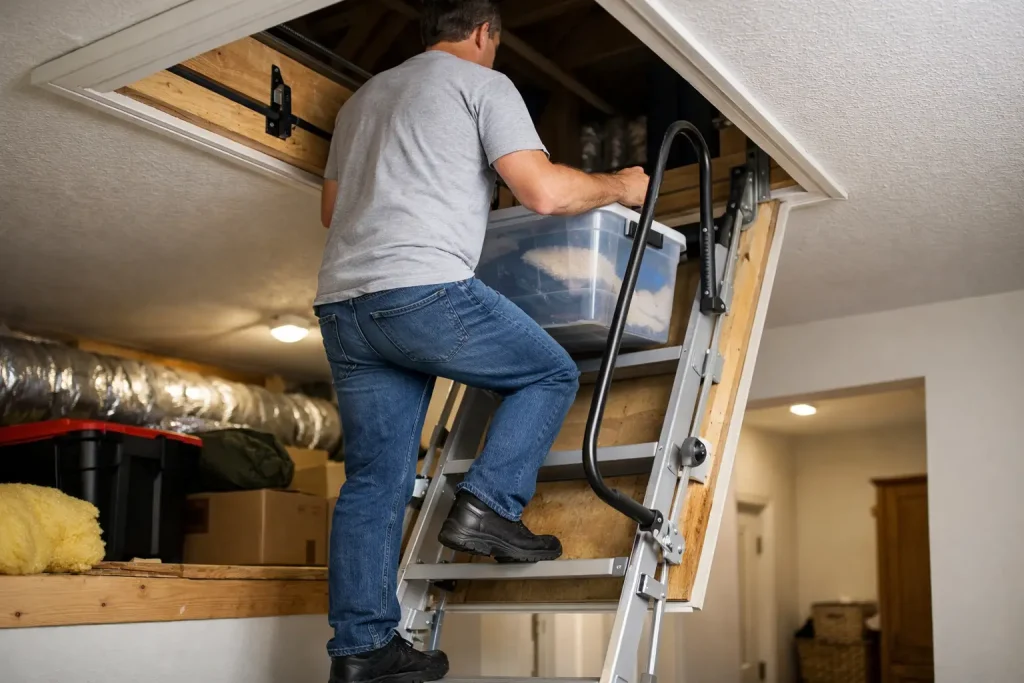
A loft can be one of the most useful storage areas in a home, but only when getting in and out of it feels safe and straightforward. If you are wondering how to make loft access safer, start by looking beyond the hatch itself. Safe access relies on several parts working together: a secure opening, a dependable ladder, good lighting, a stable surface and insulation that is protected rather than flattened.
For many households, loft access only becomes a concern after an awkward climb, a missed step or the realisation that boxes are being balanced on ceiling joists. These are warning signs worth acting on. A few well-chosen improvements can make everyday storage safer, protect your home from heat loss and make the loft a space you can use with confidence.
Start with a secure, practical loft hatch
The hatch is the first part of the journey, so it needs to be the right size, properly fitted and easy to operate. A small or poorly positioned opening can make carrying even a light storage box unnecessarily difficult. It can also encourage people to twist, stretch or climb at an awkward angle while entering the loft.
A larger hatch may be a sensible option where the existing opening is restrictive, particularly for families who need regular access to seasonal items, luggage or household storage. The right size depends on the layout of the landing, the ceiling construction and the room below. It should provide comfortable access without creating disruption to the surrounding area.
Security and insulation matter here too. A hatch should close neatly, sit securely in its frame and have effective draught sealing. Gaps around an older hatch can allow warm air to escape into the loft, making the home harder to heat. An insulated hatch helps maintain comfort downstairs while giving you a safer, more solid entrance point overhead.
Choose a loft ladder designed for regular use
A chair, a stepladder or an improvised climbing arrangement is not a dependable long-term solution. It may seem manageable for a quick task, but the risk increases when you are carrying belongings, wearing slippery socks or trying to keep your balance on a narrow step.
A purpose-fitted loft ladder gives you a consistent route into the loft. It should be securely fixed, open and close smoothly, and have treads that provide a reassuring foothold. Handrails can add useful support, especially where access is frequent or where someone in the household is less steady on their feet.
There is no single ladder that suits every property. Folding, sliding and telescopic styles all have their place, depending on available headroom, hatch size and the space beneath the opening. The key is not simply fitting a ladder that reaches the floor. It is choosing one that can be used comfortably, without overreaching or forcing the user into an awkward position.
A professional survey is valuable because it considers the complete route, from the landing floor to the first safe point inside the loft. This avoids a common problem where a new ladder improves the climb but still leaves an unstable step at the top.
Make the first steps inside the loft safe
Once you have climbed through the hatch, you need somewhere firm to stand. This is where many lofts fall short. Ceiling joists are not a safe walking surface, and there is a real risk of stepping between them and damaging the ceiling below.
A properly installed boarded area creates a clear, stable platform around the hatch and along the route to your stored items. It should be wide enough to move naturally rather than requiring you to shuffle sideways or balance on a narrow strip. If storage will be used regularly, it makes sense to plan a sensible walkway rather than boarding only a small square at the entrance.
The structure beneath the boards is just as important as the boards themselves. Modern insulation needs to retain its depth to perform properly. Compressing it beneath boarding reduces its effectiveness, which can contribute to greater heat loss and higher energy bills.
Raised loft boarding solves this problem by creating a platform above the insulation. In newer homes, using NHBC approved loft legs is particularly important, as they help maintain the required insulation depth while protecting the property’s new-build warranty. The result is a level, usable storage area without sacrificing thermal performance.
How to make loft access safer with proper lighting
A loft that is difficult to see in is difficult to use safely. Natural light from a landing is rarely enough once the hatch is closed above you, and a torch can leave one hand unavailable when you need it most.
Fixed lighting near the hatch and across the boarded route makes a genuine difference. It allows you to see the ladder opening, check your footing and find stored items without moving boxes around in the dark. A clearly positioned switch near the loft entrance is the most practical choice, so the area is lit before you step off the ladder.
Lighting also helps reveal potential problems early. You are more likely to notice a loose item, a disturbed section of insulation or a stored box that has become damp when the space is properly illuminated. This is a simple improvement, but it supports every other safety measure in the loft.
Store belongings without creating new hazards
Even a well-boarded loft can become unsafe if it is overfilled or poorly organised. Heavy belongings should not be stacked high or placed where they need to be reached over an unboarded area. Keep the route from the hatch clear at all times, including the space where you step off the ladder.
Use sturdy, manageable boxes rather than oversized containers that are difficult to lift through the hatch. Labelling them clearly means less searching and less unnecessary movement in a confined space. It is also sensible to keep the items you use most often closest to the access point, while lighter seasonal belongings can be stored further back.
Avoid placing items directly on insulation or pushing boxes tightly against roofing materials. The loft still needs airflow, and stored possessions should not interfere with ventilation. If you are unsure where storage can safely go, a specialist can assess the layout and recommend a practical boarded area rather than guessing at the limits of the space.
Do not overlook the condition of the loft
Before making access easier, it is worth checking whether the loft itself is in suitable condition for storage. Signs of damp, staining, condensation, pest activity or damaged timbers should be investigated before boarding or storing possessions. Covering a problem with boxes makes it harder to spot and may lead to more costly repairs later.
Insulation should also be assessed as part of the work. Older materials may be uneven, insufficient or displaced around the hatch. Improving insulation alongside raised boarding can make the loft safer to use and help reduce heat loss through the roof. For homeowners looking to improve comfort and support a better EPC rating, this combination is often a practical investment.
Use a specialist installation for a joined-up solution
Loft access is safest when the hatch, ladder, boarding, insulation and lighting are considered together. Fitting one element in isolation can leave another weak point behind, such as a good ladder leading onto an unboarded surface or new boarding that compresses the insulation beneath it.
A clear survey should identify what your loft can realistically accommodate and explain the options in plain language. You should know where the boarded area will go, how the insulation will be protected and what the finished access route will feel like before work begins. Written quotes and insured workmanship provide further reassurance that the installation is being handled properly.
For homeowners across Milton Keynes and nearby areas, Loft Accessories provides this specialist approach with friendly advice and tidy, reliable installation. The aim is not to fill every inch of a loft. It is to create safe, useful storage that works well for your household and protects the home around it.
A safer loft should make daily life easier, not give you another thing to worry about. When the route up is secure, the footing is stable and the insulation remains effective, you can store what you need overhead with far greater peace of mind.