
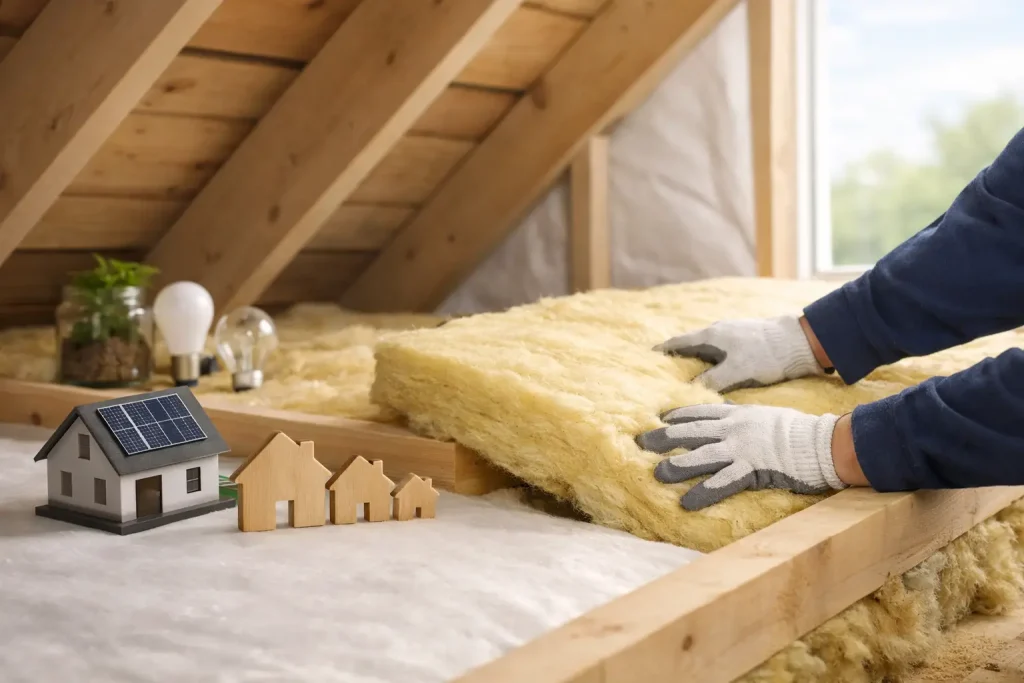
If your EPC feels like a dry bit of paperwork that only matters when you sell or let your home, your heating bills will tell a different story. One of the most effective ways to improve EPC rating with insulation is to deal with the part of the house that loses heat fastest – the loft. Get that right and you can make the home warmer, cheaper to run and more appealing on paper at the same time.
For many households, the loft is where good intentions go to fade. There may be some older insulation, a few boxes balanced awkwardly across joists, and not much confidence that it is all doing the job properly. That matters because EPC assessments look closely at insulation levels, and older or poorly installed loft insulation can hold a rating back more than many homeowners realise.
Why loft insulation matters so much for EPCs
An EPC is built around energy efficiency. It estimates how much it costs to heat and power a property, then grades the home from A to G. While the calculation takes in several factors, loft insulation is one of the simpler improvements with a clear effect because heat rises, and an underinsulated roof space lets too much of it escape.
That is why loft work often gives homeowners a practical return. You are not making a cosmetic change. You are improving thermal performance in a part of the house that directly affects comfort. In winter, rooms below the loft tend to feel less draughty and hold their temperature for longer. Over time, that can mean less strain on your heating system and lower monthly costs.
It also helps that loft insulation is easy for assessors to identify. If there is a proper depth of insulation in place, it can support a stronger EPC outcome in a very visible way. Compared with some upgrades that are expensive or disruptive, this is often a straightforward improvement with clear benefits.
How to improve EPC rating with insulation the right way
The key word is right. Adding insulation is not just a matter of putting more material in the loft and hoping for the best. The standard, condition and layout all matter, especially if you also want usable storage.
A common issue is older insulation that no longer meets current expectations. Many homes still have a thin layer that was acceptable years ago but now falls short. Topping that up can improve performance, but the loft should first be checked properly. If insulation is patchy, compressed or disturbed around the edges, the result may be less effective than expected.
Another problem is loft boarding laid directly on top of insulation. This tends to squash the material, reducing its ability to trap heat. It also creates a false economy. Homeowners think they have insulation and storage, but in reality the insulation is underperforming and the boarding can compromise airflow if not designed correctly.
That is why a raised loft boarding system matters in homes where storage space is important. It allows the insulation to sit at the correct depth without being compressed, while still creating a sturdy platform above. In newer homes, this needs to be handled especially carefully. Using NHBC approved loft legs helps protect the insulation and preserve the validity of the NHBC 10-year guarantee.
The difference between more insulation and better insulation
This is where honest advice matters. More insulation is not always the full answer if the existing setup is poor. Better insulation means the loft is assessed as a whole, including depth, coverage, condition and how the space is used.
For example, if insulation is missing around awkward corners, pushed aside near the hatch or flattened beneath stored items, the thermal benefit drops. If the loft hatch itself is poorly insulated or draughty, warm air can still escape. If access is awkward, people often avoid using the space properly, which leads to clutter being piled on top of insulation and causing further problems.
A good installation looks at all of this together. The loft should remain accessible, safe to use and properly insulated without one goal undermining another. That joined-up approach is usually what makes the difference between a quick fix and a worthwhile improvement.
Storage and insulation should work together
Many homeowners worry that improving insulation means losing their loft as a storage area. In practice, it should not be a choice between energy efficiency and usable space.
With the right raised boarding system, you can keep a practical storage area while allowing the insulation underneath to perform properly. That matters for busy households where the loft stores seasonal items, keeps spare rooms clear and helps the home stay organised. It also means the improvement feels useful day to day, not just when an EPC certificate is produced.
Safe access plays a part too. A secure loft ladder and well-fitted hatch make it easier to use the space without disturbing the insulation. If access is unsafe or awkward, people are more likely to step on joists incorrectly, crush insulation or avoid the loft altogether. When the installation is planned properly, the whole space works better.
What an EPC assessor is likely to notice
EPC assessments are not intrusive, but they do record visible features and compare them with standard assumptions. In the loft, that means insulation depth and presence can have a direct effect on the rating. If the assessor sees modern, adequate insulation, that generally supports a better score than a loft with older, thinner material.
It is also worth remembering that EPC improvements are cumulative. Loft insulation may not transform every property from a low rating to a high one on its own, especially in older homes with other efficiency issues. But it often contributes strongly because it addresses a major source of heat loss.
For homeowners thinking ahead to a sale, remortgage or simply future-proofing the property, this matters. Buyers increasingly notice running costs, and an improved EPC can make the home look more sensible to own. It is not only about ticking a box. It is about showing that the property has been looked after in a practical, cost-conscious way.
When insulation upgrades make the most sense
Some homes are obvious candidates. If the house feels cold upstairs, if heating bills have crept up without much explanation, or if the loft insulation has not been reviewed for years, there is a good chance improvement is overdue.
It also makes sense when the loft is being made more accessible for storage. This is often the ideal moment to sort the insulation properly rather than boarding over old problems. The same applies after moving into a property, when many homeowners discover the loft is either underused or poorly set up.
In areas such as Milton Keynes, Bedford, Northampton and Oxford, there is a broad mix of housing stock, from newer estates to older family homes. That means there is no single answer for every loft. Some require a simple insulation upgrade. Others need a more considered layout so storage, access and thermal performance all work together.
Why professional installation matters
Loft insulation can look simple from ground level. It is only when the loft is inspected properly that the awkward details become clear – uneven joists, limited head height, existing boarding, cables, pipework and insulation that has been disturbed over time.
A specialist approach helps avoid the usual mistakes. The insulation needs to achieve the right depth. Ventilation must be respected. Boarding should be raised, not laid directly onto the insulation. Access should be safe and practical. And the finished loft should be left clean, tidy and genuinely usable.
That is the difference between a job that merely adds material and one that improves the home properly. For a family-run specialist such as Loft Accessories, the aim is not just to install something and move on. It is to give homeowners clear advice, a written quote and a result that makes sense both on the EPC and in everyday life.
If you want to improve EPC rating with insulation, start by looking at the loft as part of the whole home, not a forgotten void above the ceiling. When insulation, boarding and access are planned together, you get a warmer house, better storage and a practical upgrade that keeps paying you back.