
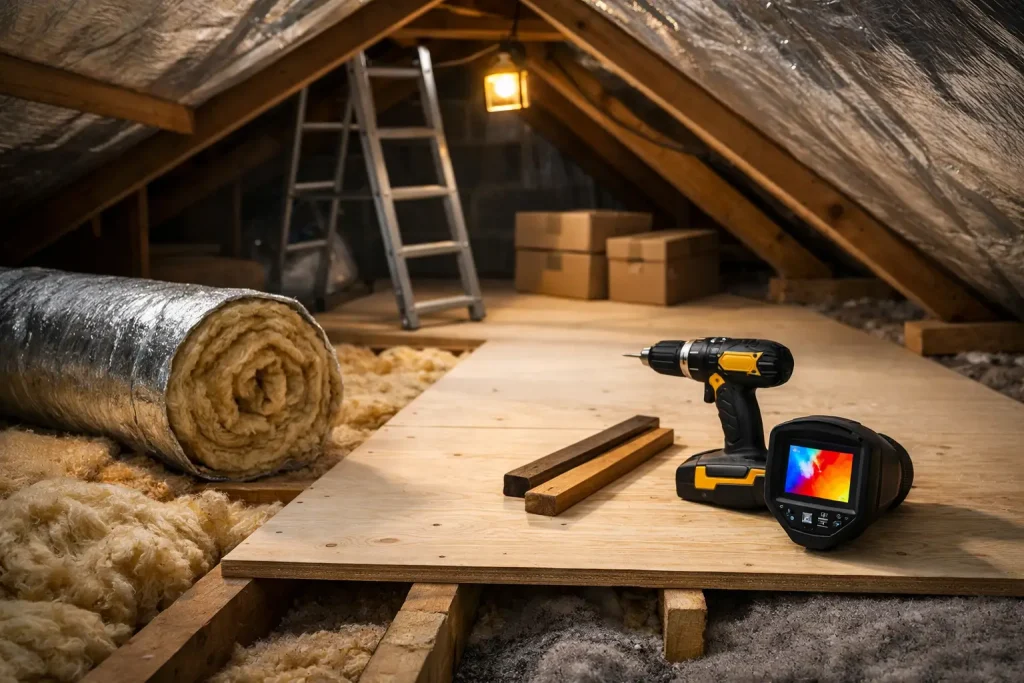
Cold upstairs rooms and rising heating bills often send homeowners looking at their loft first. It is a sensible place to start, but the answer to can loft boarding reduce heat loss is a bit more specific than a simple yes or no. Loft boarding can help protect the performance of your insulation and make your home more efficient, but only when it is installed in the right way.
A poorly boarded loft can do the opposite. If boards are laid directly on top of insulation, they compress it. Once insulation is squashed, it loses much of the trapped air that helps it slow heat escaping through the roof. So the real question is not just whether you should board the loft, but how that boarding is designed and fitted.
Can loft boarding reduce heat loss when fitted properly?
Yes, it can. Proper loft boarding supports safe storage without undermining the insulation that keeps warmth inside your home. The key is raised boarding, where the deck sits above the insulation rather than pressing down onto it.
In many homes, especially newer ones, the recommended depth of loft insulation is far greater than the height of the ceiling joists. That means there usually is not enough room to board directly onto the joists without flattening the insulation. Raised systems solve that problem by creating a gap above the insulation, allowing it to stay full depth and work as intended.
That matters because most heat loss through the loft happens when insulation is missing, disturbed or compressed. Boarding itself is not an insulating material in the same way mineral wool is, but it plays an important supporting role. It helps keep the loft usable without sacrificing thermal performance.
Why loft boarding sometimes makes heat loss worse
This is where many homeowners get caught out. They want more storage, they need a safer surface to walk on, and boarding seems like the obvious answer. But if the installation ignores the insulation below, the result can be higher heat loss rather than lower.
When insulation is compressed, its effectiveness drops. Even a decent layer can underperform if it has been flattened beneath chipboard. Gaps can also appear around the edges, and those weak spots allow warm air to escape more easily. In practical terms, that can mean rooms below feel colder and the heating has to work harder.
There is also the issue of ventilation. A loft needs proper airflow to help manage moisture. If boarding and insulation are fitted without care, airflow at the eaves can be restricted. Over time, trapped moisture can lead to condensation problems, which no homeowner wants hidden above the ceiling.
That is why specialist installation matters. A usable loft should not come at the expense of warmth, safety or the long-term condition of the roof space.
The relationship between loft insulation and boarding
If you are deciding between insulation and boarding, it is usually the wrong way to frame it. In most cases, the best result comes from both working together.
Insulation is what slows the transfer of heat. Boarding gives you safe, practical access and storage. On its own, boarding does not replace insulation. On top of compressed insulation, it can be counterproductive. Installed above a properly sized layer of insulation, it becomes part of a better overall solution.
For many households, this is the difference between a loft that is technically there and a loft that is genuinely useful. You get a firm platform for boxes and seasonal items, while your home keeps the thermal benefit of a well-insulated roof space.
This is especially relevant in homes where clutter ends up piled onto insulation or balanced between joists. That kind of storage can squash insulation just as badly as badly fitted boards can. A raised boarded area helps keep things neat and protects the insulation from accidental damage.
Can loft boarding reduce heat loss in newer homes?
It can, but newer properties need particular care. Modern homes are often built with deeper insulation requirements, and many are still within the NHBC warranty period. If loft boarding is added without the correct raised system, it may affect both insulation performance and the terms of that guarantee.
Using NHBC approved loft legs in suitable new-build installations keeps the boarding above the insulation and helps preserve the intended thermal standard of the property. It also means the loft remains practical for storage without interfering with the structure below.
For homeowners, the benefit is straightforward. You do not have to choose between keeping your warranty intact and making the loft usable. With the right approach, you can have both.
What kind of heat-loss improvement should you expect?
This depends on the starting point. If your loft already has good insulation at the correct depth and it has not been compressed, adding boarding alone may not transform your heating bills overnight. What it does do is help preserve that insulation, protect it from damage and make the space much more practical.
If the loft has thin, patchy or flattened insulation, the improvement can be more noticeable when boarding is carried out alongside insulation upgrades. In that situation, homeowners often feel the difference in overall comfort as much as they see it in energy costs. Upstairs rooms may stay warmer, and the house can feel less draughty.
There is also a wider property benefit. Better insulation and a properly finished loft space can support improved energy efficiency, which may contribute positively when the home is assessed for EPC performance.
Still, honest advice matters here. Loft boarding is not a magic fix for every heat-loss issue. Windows, walls, draughts and heating system efficiency all play their part. But the loft is one of the most sensible areas to address because warm air rises, and any weakness at ceiling level tends to show up quickly in both comfort and cost.
Signs your current loft setup may be costing you heat
A few warning signs come up time and again. If you can see boards sitting directly on joists with insulation tightly squashed underneath, there is a good chance performance has been reduced. If the loft has little insulation at all, or if it looks uneven and disturbed, heat may be escaping more readily than it should.
Another common issue is a loft that feels awkward to use. When access is poor, homeowners often end up stepping on insulation, shifting it out of place or storing items in a way that damages it over time. Better boarding and access do more than improve convenience – they help maintain the energy efficiency you are paying for.
A professional survey usually makes the picture much clearer. It shows how much insulation is there, whether it is at the right depth, how the loft is ventilated and what type of boarding system would suit the property.
Why professional fitting makes the difference
Loft work can look simple from below, but getting it right involves more than laying boards. The installer needs to assess joist levels, insulation depth, ventilation paths, safe loading and access. In newer homes, they also need to consider warranty-friendly methods and approved components.
That is why many homeowners prefer to use a loft specialist rather than a general tradesperson. A specialist understands how to create a storage area that is solid, safe and energy-conscious at the same time. The process should also be straightforward – clear advice, a written quote, tidy workmanship and no guesswork about what is happening above your ceiling.
For families trying to make better use of their home, that practical reassurance matters just as much as the technical detail.
The real answer for homeowners
So, can loft boarding reduce heat loss? Yes – when it is part of a properly planned loft system that protects insulation rather than crushing it. The biggest benefit often comes from combining raised boarding with the right insulation depth, safe access and careful installation.
If your loft is currently an awkward, underused space, there is a good chance it could work harder for your home. Done properly, boarding gives you reliable storage and helps support the warmth and efficiency you want from the rooms below.
If you are unsure what is happening under your existing boards, or whether your insulation is doing its job, the most useful next step is a clear assessment of the space. A good loft should not force you to choose between storage and energy efficiency.