
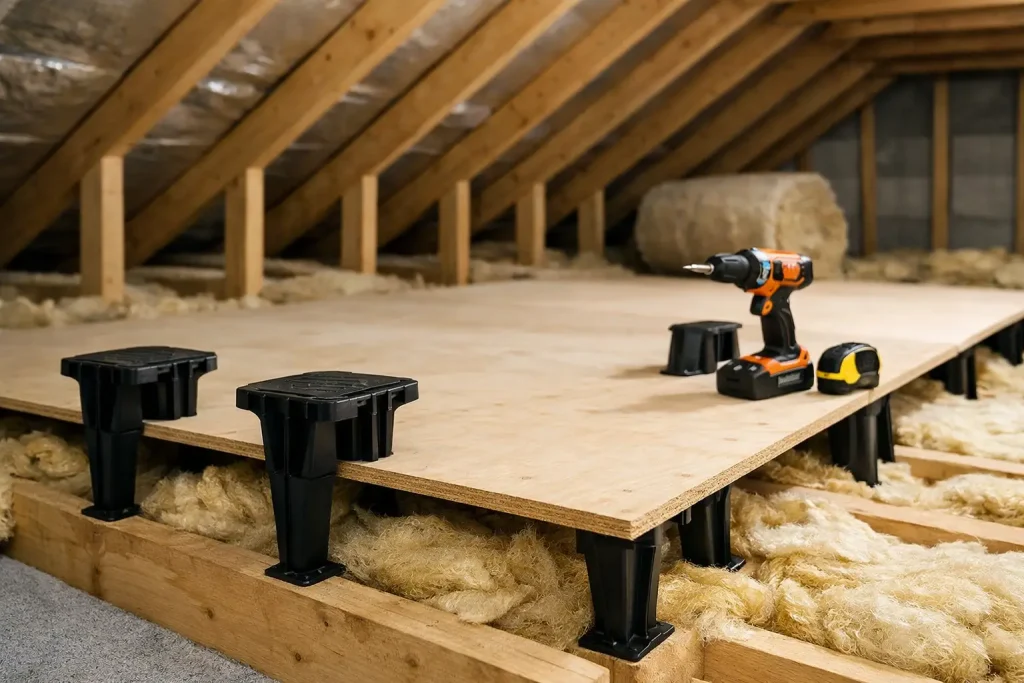
You do not need many trips into a new-build loft to spot the problem. There is plenty of space above your head, but not much of it is safely usable. That is exactly why loft legs for new builds matter. They create a raised platform above the insulation, so you can gain practical storage space without flattening the very material that helps keep your home warm.
For many homeowners, the loft becomes a holding area for suitcases, decorations, keepsakes and the things you do not need every day but do want to keep. In a newer property, though, the loft structure and insulation levels need more care than people often expect. What looks like an easy area to board can quickly become a problem if the insulation is compressed or the wrong system is fitted.
Why new-build lofts need a different approach
New homes are typically insulated to a higher standard than older properties. That is good news for energy efficiency, but it does change how loft boarding should be done. Thick insulation is usually laid between and above the joists to reduce heat loss. If boards are fixed directly onto the joists, that insulation gets squashed.
Once insulation is compressed, it cannot perform as intended. The result can be more heat escaping through the roof, colder rooms below and higher heating bills. That defeats the point of having a well-insulated home in the first place.
There is also the question of your property warranty. In many new-build homes, the loft should be treated with care so any storage solution does not interfere with the intended performance of the insulation or create avoidable issues later on. This is why a proper raised boarding system is so important.
What are loft legs for new builds?
Loft legs are strong plastic supports fitted on top of the ceiling joists. They lift the loft boards above the insulation, creating a gap that allows the insulation to remain at its full depth. The boards then sit on top of the legs, giving you a firm decked area for light storage.
In new-build properties, this raised system is not just a nice extra. It is the sensible way to make the loft usable while protecting the energy performance of the home. The detail matters here. Not all supports are the same, and not every loft should be boarded in exactly the same way.
Why NHBC approved loft legs matter
For homeowners in a newer property, product choice is not something to treat casually. NHBC approved loft legs are designed to suit the requirements of many new-build installations, helping to ensure the loft boarding is raised correctly above the insulation.
That matters because the goal is not simply to add boards. The goal is to add storage without creating problems with insulation depth, airflow or warranty concerns. Used properly, NHBC approved loft legs help preserve the intended build standard of the property while still giving you a practical storage platform.
The real benefit is not just storage
Most people start by thinking about space. They want to clear the spare room, free up a cupboard or stop boxes piling up on top of wardrobes. Fair enough. But the value of loft legs goes beyond that.
A raised loft boarding system helps protect thermal performance. That can support lower heating costs over time and help your home stay more comfortable through the colder months. It also gives you a safer, more stable surface than balancing items across ceiling joists or placing them directly onto insulation.
There is a quality-of-life benefit as well. A properly boarded loft with suitable access is easier to use, easier to keep organised and far less frustrating than a loft you avoid because it feels awkward or unsafe.
When loft legs for new builds are the right choice
In many cases, loft legs for new builds are the best solution where the homeowner wants light storage and the insulation needs to remain uncompressed. That is often the sweet spot. You are not trying to turn the loft into something it is not. You simply want to use the available space properly.
That said, every loft has its own layout, joist spacing, insulation depth and access considerations. Pipework, cables, water tanks and the position of the hatch can all affect what is practical. Some lofts benefit from partial boarding rather than covering every inch. In fact, that is often the better option, because it keeps the focus on useful storage areas rather than filling the whole loft for the sake of it.
This is where a professional survey makes a difference. It allows the loft to be assessed properly so the boarding suits the property, not the other way round.
What a good installation should include
A reliable loft boarding job in a new-build home should start with a clear assessment of the loft structure, insulation levels and intended use. From there, the raised supports should be fitted carefully and evenly, with boards installed to create a stable storage area without crushing insulation below.
Just as importantly, the work should be tidy and well explained. Homeowners should know what area is being boarded, what weight limits apply and how the system protects the insulation. Straightforward written quotes and honest recommendations matter here. Some lofts are suitable for more extensive boarding, while others are better served by a smaller decked area combined with improved access and insulation upgrades.
A proper installation should also take the loft hatch and ladder into account. There is little point creating storage space if getting to it remains inconvenient or unsafe. When these elements are planned together, the loft becomes far more usable day to day.
Common mistakes to avoid
The biggest mistake is treating a new-build loft like an older one and boarding directly over the joists. It may look quicker at first, but it can reduce insulation performance and create problems you only notice later when the house feels colder or energy bills creep up.
Another common issue is assuming more boarding is always better. In practice, careful design matters more than sheer coverage. A well-placed storage platform near the hatch with safe access can be more useful than a larger boarded area that is awkward to reach or difficult to use.
It is also worth avoiding vague pricing or one-size-fits-all promises. New-build lofts deserve a bit more care than that. The right recommendation depends on the property, the insulation depth and how you actually plan to use the space.
A practical upgrade for growing households
For families, loft storage tends to become more valuable over time. Pushchairs, travel cots, school keepsakes, seasonal decorations and paperwork all need a home somewhere. Long-term homeowners often reach the same point from a different direction. They simply want the house to work better without losing a bedroom to storage.
That is why loft boarding with the right raised support system is such a sensible improvement. It makes use of space you already have, helps protect the insulation already in place and adds convenience without unnecessary upheaval.
In areas such as Milton Keynes, where many homeowners live in modern properties, this kind of upgrade often makes immediate practical sense. It is not about overcomplicating the loft. It is about making it safe, accessible and fit for purpose.
Choosing the right specialist
New-build loft work is best handled by a company that understands the difference between creating storage and protecting the performance of the home. That means knowing how to work with modern insulation standards, using suitable raised systems and being clear about what the loft can and cannot be used for.
A specialist should be happy to explain the options in plain English, provide a written quote and complete the work cleanly and professionally. Loft Accessories, for example, uses NHBC approved loft legs for new home installations so homeowners can gain a solid storage platform while helping to protect their warranty and insulation performance.
If your loft has become a wasted space because you were unsure what could safely be done with it, that hesitation is understandable. New-build homes need the right approach. The good news is that with the proper system in place, your loft can become one of the most useful storage areas in the house without compromising the comfort and efficiency of the rooms below.