
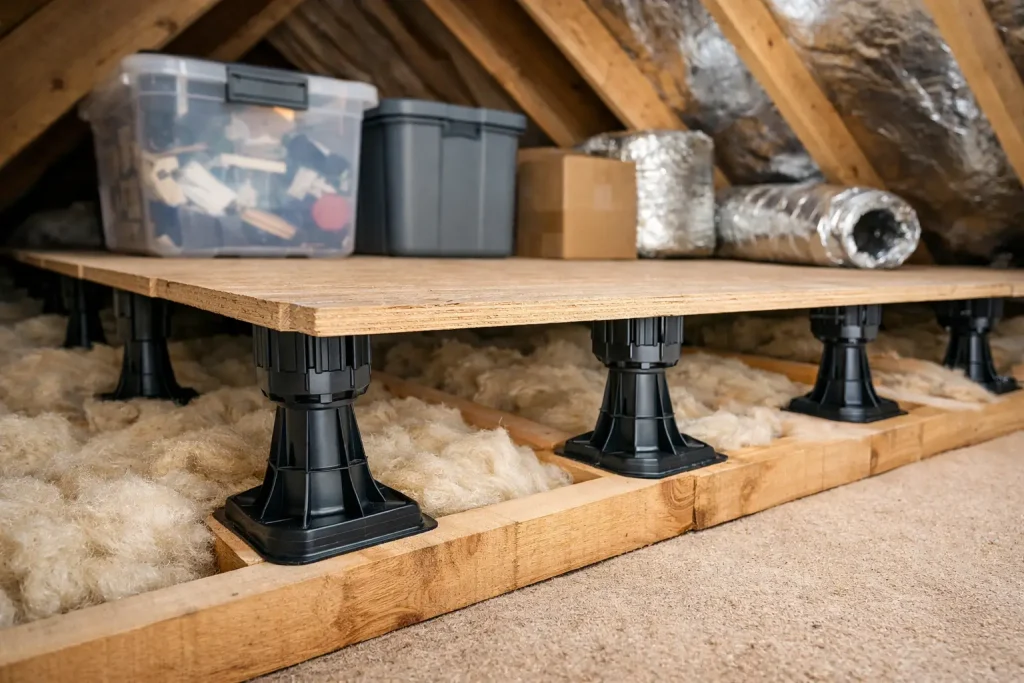
If your loft is boarded directly onto the joists, there is a good chance the insulation underneath is being squashed. That is exactly why homeowners start looking into the benefits of raised loft legs. They create a raised platform above the insulation, giving you practical storage space without compromising the thermal performance that helps keep your home warmer and cheaper to run.
For many households, the loft ends up as a missed opportunity. There is space up there, but it is awkward to use properly, and in some cases previous boarding has made things worse rather than better. Raised loft legs solve a very common problem in a straightforward way. They allow a secure boarded area to sit above the insulation, so you can use the loft as intended while still protecting your home’s energy efficiency.
What are raised loft legs?
Raised loft legs are strong supports fixed to the loft joists before boarding is installed. Their job is simple. They lift the boarding above the insulation, leaving enough depth for the insulation to do its work properly.
That gap matters more than many people realise. Modern insulation often needs a greater depth than the joists alone can accommodate. If boards are laid straight across without raising them, the insulation gets compressed. Once that happens, it cannot trap heat as effectively, which can lead to higher energy use and a colder home.
The main benefits of raised loft legs
They protect your insulation from compression
This is the biggest advantage, and usually the reason loft legs are recommended in the first place. Insulation works best when it keeps its full depth and loft. When it is flattened under boards, its performance drops.
Raised loft legs prevent that compression by creating the clearance needed above the insulation. That means your home keeps the benefit of the insulation you have paid for, rather than losing performance because the loft has been boarded incorrectly.
They help reduce heat loss
A loft is one of the main places where heat can escape from a property. If the insulation is compromised, your heating system has to work harder to maintain a comfortable temperature downstairs.
One of the practical benefits of raised loft legs is that they support proper insulation depth, which helps reduce heat loss through the roof space. You may not notice it overnight, but over time it can contribute to a more energy-efficient home and lower monthly heating bills.
They create usable storage without wasting space
Many homeowners assume they have to choose between insulation and storage. In reality, a well-planned raised loft floor gives you both. By lifting the boards above the insulation, loft legs turn an awkward area into usable storage space without undermining the purpose of the insulation below.
That can make a real difference in family homes where cupboards are full, spare rooms are under pressure, and seasonal items need a proper place. Suitcases, decorations, keepsakes and less-used household items can be stored neatly overhead rather than cluttering up the living space.
They provide a safer and more stable boarded area
A raised loft storage platform is not just about convenience. It is also about safety. A professionally installed boarded area gives you a clear, stable surface to use when placing or retrieving stored items.
Without that, people often end up stepping awkwardly around joists or balancing on unsuitable surfaces, which is never a good idea in a loft. A proper raised system helps create a more secure area to access and use, particularly when combined with suitable loft access and lighting.
They can support newer build requirements
In newer homes, this point is especially important. Some properties are covered by NHBC standards, and storing items in the loft needs to be handled carefully if you want to avoid affecting your warranty position.
Using NHBC approved loft legs can help ensure the boarding is raised above the insulation in a way that is suitable for modern homes. It is one of those details that may seem small now but matters later. If you own a newer property, it is worth getting clear advice before any boarding is fitted.
They help keep the loft ventilated properly
A loft needs a sensible balance of insulation and airflow. Raised boarding systems can help maintain that balance because they avoid pressing materials together in a way that interferes with how the roof space performs.
This does not mean every loft has identical ventilation needs. Some properties need a closer look, particularly older homes or lofts where insulation has been added in stages over the years. Even so, keeping the insulation at the right depth is a sensible starting point for a healthier, better-performing loft space.
They add practical value to your home
Home improvements do not always need to be dramatic to be worthwhile. Better loft storage, improved energy efficiency and safer access all add day-to-day value. For many homeowners, that is more useful than a cosmetic update that looks good for a while but changes very little.
Raised loft legs support a neat, functional storage area that makes the house easier to live in. If you are planning to stay in your property long term, that matters. If you are thinking ahead to future saleability, buyers also tend to appreciate homes with sensible storage and good energy performance.
Why direct boarding can cause problems
It is easy to see why some lofts were boarded directly in the past. Older insulation standards were different, and many people simply wanted somewhere to put boxes. The problem is that current insulation depths are often much greater than the joist height, so laying boards straight on top is no longer a sound solution.
Once insulation is compressed, you lose efficiency. In some lofts, direct boarding can also make it harder to assess the condition of the insulation underneath or spot issues early. What looked like a simple storage fix can end up working against the home.
That does not mean every loft needs exactly the same raised height or boarding layout. The right approach depends on the property, the insulation already in place and how much storage you actually need. Good advice should be based on the loft in front of you, not a one-size-fits-all recommendation.
Are raised loft legs right for every home?
In many cases, yes, but there are still details to assess properly. The condition of the joists, the amount of insulation, head height, access and the intended use of the loft all matter. Some homeowners only need a modest storage area near the hatch. Others want a larger boarded section that works neatly around the layout of the roof space.
That is why a proper survey is so useful. It allows the loft to be checked properly, the options to be explained clearly and the quote to reflect what the home actually needs. Straightforward advice at the start usually saves hassle later.
The benefits of raised loft legs go beyond storage
It is tempting to think of loft legs as a small fitting detail, but they have a direct effect on how well the whole loft setup performs. The benefits of raised loft legs include preserving insulation depth, improving the usefulness of the space and supporting a safer, tidier storage area.
For households trying to make better use of their home without taking on major building work, that is a practical improvement. It solves a real problem and does it in a way that supports comfort, efficiency and everyday convenience.
In places like Milton Keynes and the surrounding areas, where many homes need better storage and improved thermal performance rather than grand changes, this sort of upgrade makes a lot of sense. It is simple, effective and worth getting done properly.
A loft should help your home work better, not quietly undermine its insulation. When the boarding is raised the right way, you get storage you can rely on and a home that keeps hold of its heat far more effectively.