
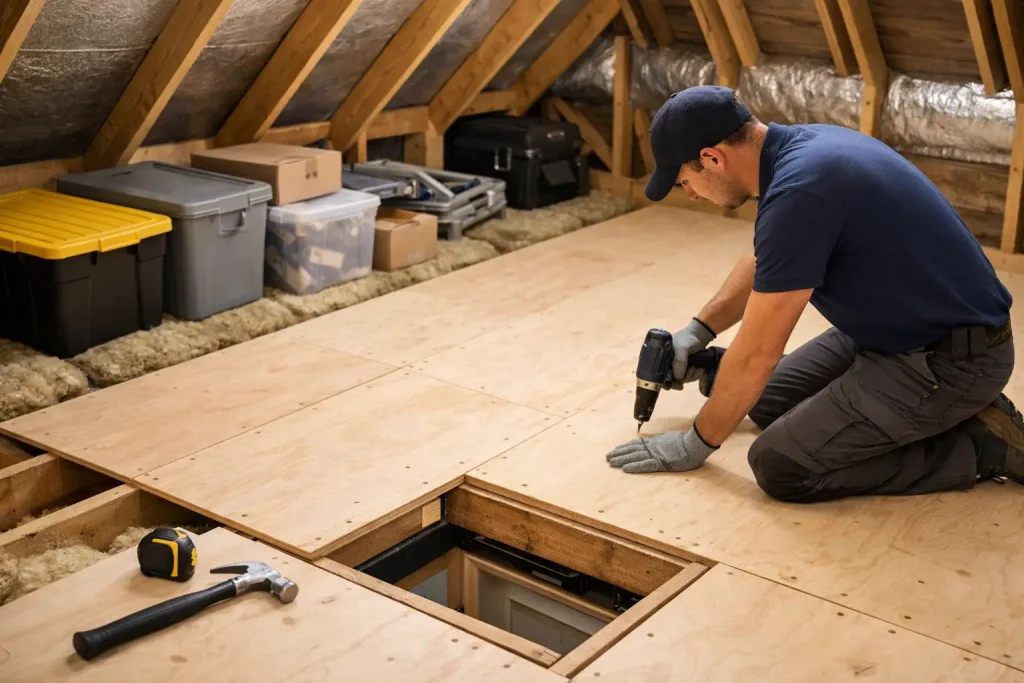
A loft often becomes the place where Christmas decorations, suitcases and family keepsakes are put away, then forgotten because getting to them is awkward or unsafe. Professional attic storage boarding services turn that underused area into practical household storage without compromising the insulation that helps keep your home warm.
The difference is not simply laying boards across the loft. A properly planned installation considers the strength and layout of the loft, the depth of insulation, safe access, lighting and the items you intend to store. Done well, it gives you a firm, accessible platform and helps protect the energy performance of your home.
Why raised boarding matters
Many homes have insulation laid between the ceiling joists. This insulation needs to retain its depth to work effectively. If boards are fitted directly on top and heavy boxes are placed above, the insulation can be compressed. That reduces the air trapped within the material, which is exactly what helps it slow heat loss.
Raised loft boarding creates a gap above the insulation, allowing it to remain at the recommended depth while providing a stable floor for storage. It is a practical detail, but one with a lasting effect on comfort and heating costs. For households already feeling the impact of higher energy bills, there is little sense in gaining storage space at the expense of thermal performance.
In newer properties, this approach is particularly important. NHBC approved loft legs can be used to raise the boarding above the insulation, helping to protect both the insulation and the terms of an NHBC 10-year guarantee. The right fixing system depends on the property, which is why an inspection before work begins is so valuable.
What a professional survey should assess
No two lofts are quite the same. The roof shape, joist direction, hatch position and existing insulation can all affect the most suitable layout. A good survey should begin with access and safety, not an assumption that every inch of the loft needs boarding.
The installer should assess the available headroom, condition of the loft structure and the route into the space. They should also look at where electrical cables, pipework, water tanks or ventilation may be located. These features do not always prevent boarding, but they must be accounted for so that the finished area remains safe and sensible to use.
Your intended use matters too. Storing light seasonal belongings calls for a different approach from keeping several heavy boxes of paperwork or household equipment. Clear advice about sensible loading helps prevent a storage area becoming overburdened over time.
A survey is also the right time to discuss insulation. If the existing layer is thin, uneven or disturbed, improving it before the boarding is fitted can make far more sense than revisiting the job later. This gives the work a clear purpose: more usable space, with better protection from heat loss.
Safe access is part of the storage solution
Boarding alone does not make a loft convenient. If the hatch is too small, the ladder is unsteady or there is no safe lighting, people are less likely to use the space properly. Worse, they may take risks while carrying bulky items through a narrow opening.
A suitable loft ladder and hatch can make a major difference to everyday use. The best option depends on the available space, ceiling height and how often the loft will be accessed. Some homes benefit from a larger hatch to make storage easier, while others need a compact ladder arrangement that fits neatly into a restricted landing area.
Lighting should also be considered. A simple, well-positioned light makes it easier to see where you are stepping, find stored belongings and avoid snagging cables or roof timbers. It is a small addition that makes the whole storage area feel more useful and secure.
What quality attic storage boarding services look like
The standard of preparation is often what separates a lasting installation from one that causes problems later. Boarding should be measured and fitted neatly around the features of the loft, with secure support beneath it. The aim is a solid, level platform that does not squash insulation or create unnecessary obstruction.
The work should be explained in plain language before it starts. Homeowners deserve to know how much area will be boarded, whether insulation is included, what access improvements are recommended and what the full cost will be. A detailed written quote avoids uncertainty and makes it easier to compare like for like.
Reliable service is just as important as the materials used. That means arriving as agreed, treating the property with care and leaving the work area clean and tidy. For a family home, where schedules are already busy, a straightforward process and clear communication remove much of the stress from a practical home improvement.
At Loft Accessories, free home surveys and written quotes are designed to give homeowners a clear picture of the most appropriate options before making a decision. As loft specialists, the focus is on recommending work that suits the property and the way the space will actually be used.
Choosing the right amount of boarding
More boarding is not automatically better. A fully boarded loft may be useful in some properties, but a smaller central storage platform can be the better choice where access is limited or belongings are kept to a minimum. The goal is to create useful space without blocking access to essential areas or making the loft difficult to move around in.
It is worth thinking about what genuinely needs to be stored. Seasonal items, luggage, sentimental belongings and occasional household supplies are usually well suited to a loft. Items that need frequent access may be more convenient elsewhere in the house. Keeping the loft organised with labelled boxes also helps you make the most of the boarded area and prevents unnecessary weight building up.
There can be trade-offs. Adding a larger hatch and ladder improves access, but it may require more work than a simple boarding installation. Increasing insulation can improve warmth and energy efficiency, yet it can also make raised boarding even more necessary. An honest assessment explains these choices clearly, rather than pushing a single solution for every home.
Questions worth asking before booking
Before choosing a provider, ask whether the proposed boarding will be raised above the insulation and how the existing insulation will be protected. Ask what type of boards and support system will be used, whether the work is insured, and whether the quote covers all parts of the installation.
It is also sensible to ask how the team will handle cables, pipework and any water tank in the loft. A professional should be comfortable explaining the plan and highlighting anything that needs attention before or during the work. Straight answers are a good sign that the installation is being planned properly.
For homeowners in Milton Keynes, Northampton, Bedford, Leighton Buzzard, Buckingham and Oxford, choosing an experienced local specialist can provide added reassurance. They understand the common layouts found across the area and can assess the property in person rather than relying on a one-size-fits-all estimate.
A practical improvement that keeps working
A well-boarded loft does more than hide clutter. It can free up bedrooms, cupboards and living areas, make seasonal belongings easier to find and support a warmer, more efficient home when insulation is protected properly. It is a straightforward improvement, but the details matter.
The best starting point is a friendly, no-pressure survey that looks at your loft as it is, listens to what you need from it and sets out the options clearly. With safe access, raised boarding and the right insulation in place, the space above your ceiling can become one of the most useful parts of your home.