
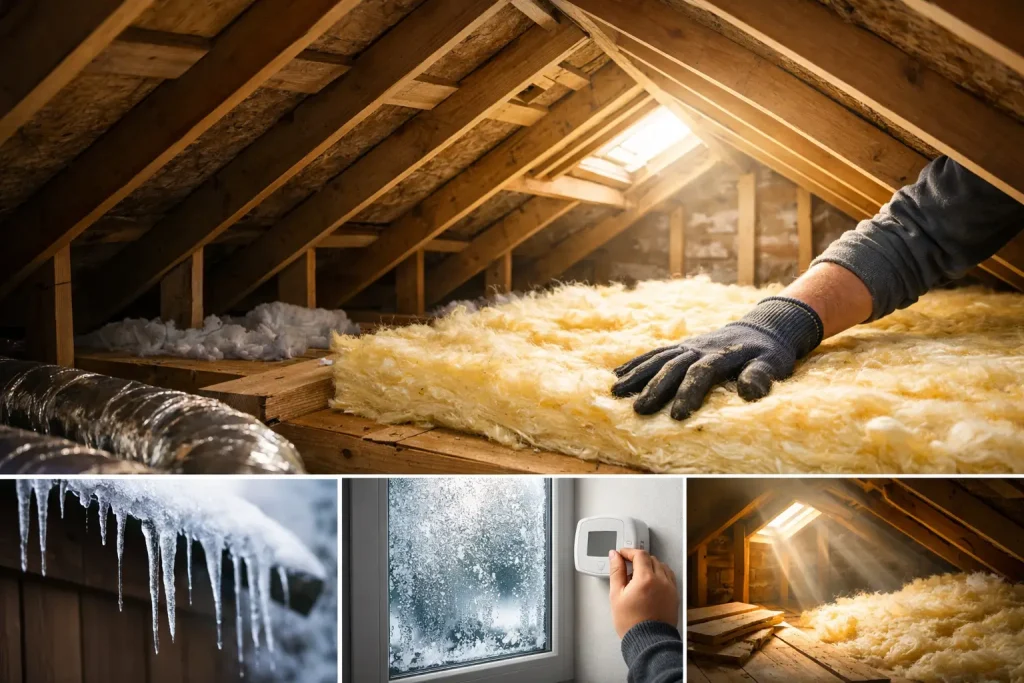
You usually notice loft insulation problems downstairs first. If your heating is working harder, certain rooms never seem to warm up, or the house cools quickly once the thermostat goes down, those are often the top signs loft needs insulation. It is easy to overlook the loft because it is out of sight, but poor insulation above your ceiling can have a direct effect on comfort, energy bills and how useful that space is.
For most homeowners, the issue is not simply whether insulation exists. The real question is whether there is enough of it, whether it has been fitted properly, and whether it is still doing its job after years of being disturbed, compressed or exposed to cold draughts. A loft can look fine at a glance and still lose a surprising amount of heat.
Top signs loft needs insulation
One of the clearest warning signs is a steady rise in heating costs without any obvious change in how you use your home. Energy prices do move around, of course, so a higher bill does not always point to the loft alone. But if your usage feels broadly the same and the house still feels colder, heat loss through the roof is worth looking at closely.
Another common sign is when the upstairs rooms feel chilly even after the heating has been on for a while. Heat rises, so if insulation is lacking, that warmth can escape through the loft instead of staying where you need it. You may notice that bedrooms are harder to keep comfortable than the rooms below, particularly in winter or on windy days.
A third clue is when the temperature in your home drops quickly. Some houses warm up reasonably fast but lose that warmth almost as soon as the boiler switches off. That pattern often suggests the property is not holding onto heat well. Windows and walls can play a part, but the loft is one of the first places a specialist would check.
Cold ceilings, draughts and uneven comfort
Sometimes the signs are more subtle. A home may not feel freezing, but it never feels consistently comfortable either. One room is warm, another is noticeably cooler, and the landing or top floor has a slight chill that never quite goes away. This unevenness can point to patchy insulation coverage, especially in older lofts where materials have shifted over time.
Cold ceilings are another indicator. You are unlikely to touch the ceiling often enough to make a habit of testing it, but some homeowners notice that upstairs spaces feel colder around head height or that the room has a general cold sink effect. That can happen when there is too little barrier between the heated room below and the loft above.
Draughts can also be linked to loft insulation, although not always in the way people expect. Insulation itself does not stop every air leak, but a poorly insulated loft often goes hand in hand with gaps around the hatch, edges, pipework or eaves. If the top floor feels draughty despite windows being shut, the loft area may be contributing to the problem.
Visible signs in the loft itself
If you have safe access and can see the loft clearly, there are a few visual hints that should not be ignored. The most obvious is very shallow insulation or large areas where the ceiling joists are still highly visible. In many homes, older insulation was installed to standards that are no longer considered sufficient. What looked acceptable years ago may now be underperforming.
You may also see insulation that has been flattened. This is especially common where items have been stored directly on top of it or where people have moved around the loft repeatedly. Compressed insulation cannot trap heat as effectively, so even if the material is technically still there, its performance may be reduced.
Gaps are just as important. A loft does not need dramatic missing sections to cause problems. Small uncovered areas around the edges, around the hatch, or where previous work has disturbed the insulation can allow heat to escape. The result is often a home that feels harder to heat than it should.
Older or poorly fitted boarding can add another layer to the issue. If boards have been laid directly onto the joists with insulation squashed beneath them, you may have lost thermal performance without realising it. In newer properties, this needs even more care, as the correct raised system helps protect both the insulation and the home’s warranty requirements.
Condensation and damp can be part of the picture
Not every insulation issue shows up as cold. Sometimes it appears as moisture. If you notice condensation in the loft, musty smells, or signs of damp on timbers or stored items, the loft may not be insulated or ventilated properly. It depends on the exact cause, because damp can come from several sources, but poor insulation can contribute by creating cold surfaces where moisture settles.
This is where a proper assessment matters. Adding more insulation is not about stuffing the loft full of material and hoping for the best. The balance between insulation, airflow and access needs to be right. Otherwise, one issue can be improved while another is made worse.
That is why specialist advice is often more useful than a quick glance. A dedicated loft company can look at the depth, condition and layout of the existing insulation, as well as how storage, boarding and access are affecting performance.
When older insulation is no longer enough
A lot of loft insulation problems come down to age rather than complete absence. Homes built or updated years ago may still have insulation in place, but not enough for modern expectations. Standards have changed, energy costs have changed, and many households now expect better comfort from the same home.
The material itself can also deteriorate. It may become uneven, dirty, damp in places or disturbed by other works. None of that automatically means a full replacement is needed, but it does mean the loft should be checked properly rather than assumed to be fine.
If your home has never had a thorough loft survey, there is a fair chance the insulation level is not as effective as it could be. This is especially true where the loft is also being used for storage. The challenge is making the space practical without compromising thermal performance. Done properly, you can have both.
Why storage problems can signal insulation issues
Many homeowners first think about their loft because they need more storage, not because they suspect heat loss. But the two often overlap. If the loft feels awkward to use, has insulation poking above joists, or has old boards laid in a way that crushes the insulation, that is usually a sign the space needs a better setup overall.
This is where a specialist approach makes a real difference. Raised loft boarding systems allow insulation to sit at the correct depth beneath the deck, so you do not have to choose between energy efficiency and usable storage. For homeowners in newer properties, using NHBC approved loft legs can also help protect the original guarantee while creating a safe platform above the insulation.
In practical terms, that means the loft becomes easier to access, safer to use and more efficient at the same time. It is not just a storage upgrade. It is often a way to correct hidden insulation problems that have been affecting the whole house.
What to do if these signs sound familiar
If several of these issues ring true, the best next step is a proper inspection by a loft specialist. That gives you a clear picture of what is there already, whether it is performing as it should, and whether the loft could benefit from additional insulation, improved boarding or better access.
It is also worth remembering that every loft is slightly different. A 1930s semi, a modern estate home and a bungalow will not always need exactly the same solution. The right approach depends on the current insulation, the roof structure, ventilation, and whether you want the space to work harder for storage as well as energy efficiency.
At Loft Accessories, we see this regularly in homes across Milton Keynes and surrounding areas. Often, people put up with cold bedrooms or rising bills for years without realising the loft is at the centre of it. Once the insulation and boarding are sorted properly, the house tends to feel more comfortable and the loft becomes far more practical.
If your home is showing the top signs loft needs insulation, it is worth dealing with sooner rather than later. Heat lost through the roof does not improve on its own, and a loft that is insulated properly, boarded correctly and safely accessible can make everyday life feel that bit easier.