
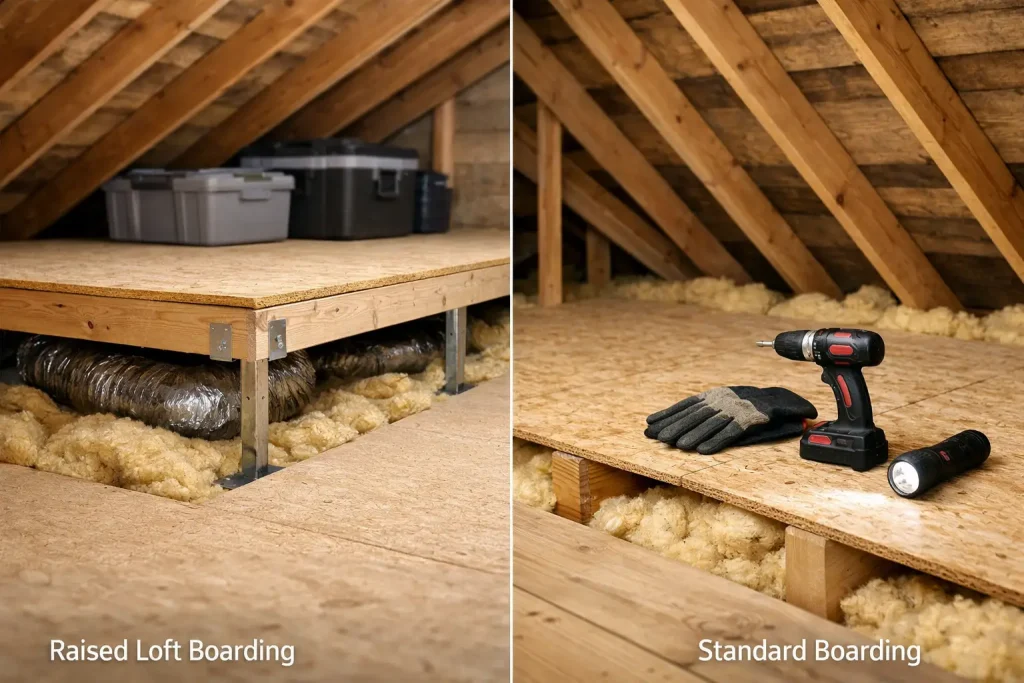
A loft can quickly become the place where Christmas decorations, children’s keepsakes and bulky household items end up, but storing them properly matters. When comparing raised loft boarding vs standard boarding, the main question is not simply which gives you a floor. It is whether that floor protects your insulation, keeps heat where it belongs and remains a safe, practical storage area for years to come.
For many homes, particularly newer properties, raised boarding is the better long-term answer. Standard boarding can still have a place in the right circumstances, but it needs to be considered carefully rather than chosen because it appears to be the simpler option.
What is standard loft boarding?
Standard loft boarding usually means fitting boards directly across the existing ceiling joists. It creates a solid surface for storage and can make a previously awkward loft much easier to use.
The issue is the insulation beneath it. Modern loft insulation is often much deeper than the joists themselves. If boards are laid straight on top, the insulation may be squashed down to fit underneath. That reduces its ability to hold warm air inside your home, which can lead to greater heat loss and higher heating costs.
In an older property with shallow insulation, or where the loft is not being upgraded at the same time, standard boarding may be discussed as an option. However, it is rarely the best choice when the aim is to improve energy efficiency as well as gain storage space.
What is raised loft boarding?
Raised loft boarding creates a platform above the insulation rather than pressing it beneath the boards. Specially designed loft legs or a suitable raised framework are fixed to the joists, and the boards sit on top of these supports.
This leaves a clear gap for insulation to retain its full depth and performance. You still have a sturdy boarded area for neatly organised storage, but the insulation can do the job it was installed to do.
The difference may not be obvious once the work is complete, as both options provide a usable floor. Under the boards, however, the construction is very different. Raised boarding respects the thermal layer in the loft; standard boarding can compromise it.
Raised loft boarding vs standard boarding: the key differences
The most significant difference is insulation performance. Insulation works by trapping pockets of air. Once compressed, those pockets are reduced, and the material becomes less effective. Standard boards laid directly over deep mineral wool can therefore undo part of the benefit of adding or topping up insulation in the first place.
Raised boarding avoids this pressure. It allows insulation to sit at its intended depth, helping the property retain heat more effectively. For homeowners concerned about rising energy bills, comfort in colder rooms or improving their home’s EPC performance, this is a practical consideration rather than a minor technical detail.
There is also a difference in the way each solution supports storage. A professionally installed raised system is designed to form a stable platform above the insulation. The installer can assess the loft layout, access point and intended use, then recommend a boarded area that is suitable for ordinary household belongings without overloading the ceiling structure.
Standard boarding may look less expensive at first because it uses fewer components. Yet the initial saving can be outweighed by poorer insulation performance, the cost of correcting compressed insulation later, or the need to have the area altered when your storage requirements change.
Why insulation depth should guide the decision
Current guidance for loft insulation commonly aims for around 270mm of mineral wool. Ceiling joists in many homes are much shallower than this, often around 100mm. That means there simply is not enough room to place boards directly on the joists without flattening a substantial amount of insulation.
A raised platform solves this neatly. It gives insulation the space it needs while creating a defined, easy-to-reach storage zone above it. The rest of the loft can remain insulated without being turned into an uneven surface that is difficult to use safely.
This matters especially in homes where insulation has been added gradually over time. A loft may already have older material between the joists and a newer layer laid across them. Before any boarding is fitted, the insulation should be checked for condition, depth and coverage. Gaps, dampness or disturbed material can affect both warmth and the suitability of the space for storage.
New-build homes and NHBC considerations
If you own a newer home, the choice deserves even more care. New-build properties are often covered by an NHBC Buildmark warranty, and changes in the loft should not compromise the original construction or warranty position.
NHBC-approved loft legs are designed for this purpose. They raise the boards above the insulation while helping to avoid unnecessary alteration to the roof structure. Used correctly as part of a professional installation, they provide a secure storage platform without compressing insulation.
It is sensible to keep written details of the work carried out and to choose a specialist who understands the requirements of newer homes. A clear survey and written quotation should explain how the proposed boarding will be supported, where it will be installed and how insulation will be protected.
Is raised boarding always necessary?
Not every loft needs a fully raised boarded floor from wall to wall. In fact, covering the whole loft is often unnecessary. Most households need a sensible central or access-area platform for boxes, suitcases and seasonal items, rather than every square metre being boarded.
The right solution depends on the insulation depth, joist layout, roof design, access and the type of items you plan to store. A small, well-planned raised area may be more useful than a larger area that restricts insulation or encourages heavy loading.
Standard boarding might be considered where insulation is shallow and there is a clear reason not to increase it. Even then, it is worth weighing the value of usable storage against the potential impact on warmth and energy use. For most homeowners who want a future-proof result, raised boarding is the stronger option.
Safe access matters as much as the boarding
A well-boarded loft is only useful if you can reach it safely. A narrow hatch, unsteady ladder or poorly positioned light can turn simple storage into an awkward task. This is why boarding, loft access and lighting should be looked at together.
A suitable loft ladder provides dependable access, while an enlarged or insulated hatch can make the opening easier to use and help reduce draughts. Good lighting means you can find what you need without balancing on a joist or moving boxes in semi-darkness.
Storage should also be kept sensible. Loft boarding is intended for normal household storage, not exceptionally heavy loads. Books, old paperwork and dense boxed items can become surprisingly weighty when concentrated in one place. Spreading items evenly and keeping the heaviest belongings near supported areas helps protect the ceiling below.
What a professional survey should cover
Before choosing between raised and standard boarding, a proper loft survey should consider more than the visible floor area. The survey should check the insulation, joists, available headroom, hatch position, ladder access and any services running through the loft.
It should also establish what you want from the space. Are you trying to clear a spare room, store seasonal belongings, improve insulation or all three? Honest advice is often about recommending the right size of storage platform, rather than the largest possible one.
For homeowners in Milton Keynes and the surrounding area, Loft Accessories provides free home surveys and detailed written quotes, so the proposed work is clear before installation begins. A tidy, insured installation by a loft specialist gives you confidence that the boarding, insulation and access have been considered as one practical solution.
The best loft storage should make everyday life easier without making your home colder. If your insulation is deep, your property is relatively new or energy efficiency is a priority, raised boarding is usually the sounder investment. A carefully planned platform leaves room for the belongings you need to keep, while allowing your loft insulation to keep working quietly above your head.