
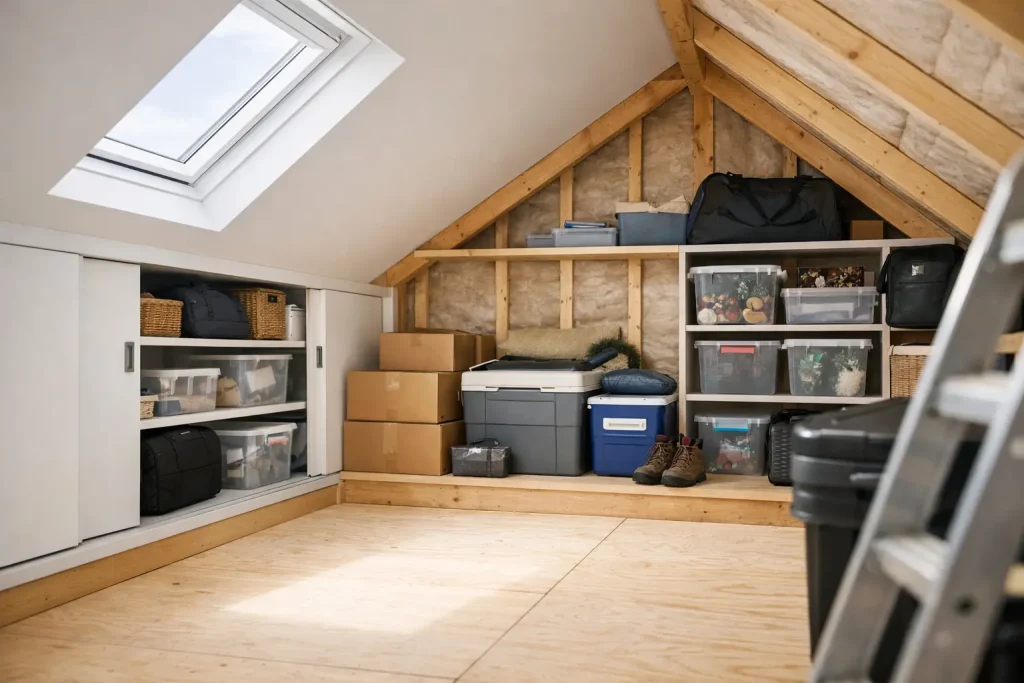
Boxes balanced on ceiling joists, insulation flattened under old boards, and a loft hatch that feels awkward every time you use it – that is often the reality in newer homes. A good new build loft storage example shows there is a better way. With the right raised boarding system, proper insulation protection and safe access, a loft can become genuinely useful storage without creating problems for your home later.
What a good new build loft storage example looks like
In many new build properties, the loft is not designed to take direct boarding laid straight over the insulation. The insulation depth is there for a reason. It helps your home hold heat more effectively, which matters when energy bills keep climbing. If boards are fitted directly on top, that insulation gets compressed and loses performance.
A proper new build loft storage example starts with raised loft boarding. This creates a stable platform above the insulation rather than squashing it down. In newer homes, that detail matters even more because the installation needs to respect the original build standards and protect the property warranty where applicable.
It is also not just about the floor. A loft that works well for storage usually includes three parts working together – boarding, insulation and access. Miss one of those and the space often ends up awkward, unsafe or far less useful than expected.
Why new build homes need a different approach
Older houses and newer houses often need different loft solutions. In a new build, the loft may look neat and accessible enough at first glance, but appearances can be misleading. The insulation is usually deeper, the truss layout can limit movement, and the wrong boarding method may create issues that are best avoided.
That is why specialist systems are important. NHBC approved loft legs are commonly used in new homes because they raise the boards above the insulation and help maintain ventilation and thermal performance. For homeowners, the key point is simple – you want storage space without undermining the way the home was designed to perform.
There is also the question of load-bearing and layout. Not every part of a loft is suitable for storage, even if technically a board could be fitted there. A sensible design focuses on creating a defined storage area with safe movement routes, rather than trying to cover every inch for the sake of it.
A realistic example for a family home
Take a typical three-bedroom new build home. The owners have the familiar problem: cupboards are full, wardrobes are overflowing, and the spare room is slowly turning into a holding area for suitcases, baby equipment, Christmas decorations and keepsakes. The loft exists, but it is not practical. The hatch is small, there is no proper ladder, and there is nowhere safe to stand once you get up there.
In this sort of case, the most effective answer is usually a raised boarding system installed over the suitable central area of the loft, paired with a secure loft ladder and, where needed, an improved hatch. That creates a clean, stable storage platform that is easy to reach and safe to use.
The result is not a vast extra room, and it is better not to think of it that way. It is organised overhead storage that takes pressure off the main living areas. For many households, that is exactly what is needed. The landing cupboard becomes usable again, the garage is less cluttered, and the spare bedroom can go back to being a bedroom.
The three details that make the difference
Raised boarding above insulation
This is the heart of any strong new build loft storage example. The boarding should sit above the insulation, not on it. That protects thermal performance and avoids the common mistake of reducing the very insulation that helps keep the house warmer in winter and cooler in summer.
For homeowners, the benefit is practical as much as technical. You get a proper storage deck and your insulation can continue doing its job. It is a smarter long-term choice than a quick fix that causes hidden inefficiency.
Safe and straightforward access
Storage is only useful if you can reach it comfortably. A loft ladder should feel secure underfoot, open and close smoothly, and suit the available space below. The hatch also matters. In some homes, the existing opening is small or awkwardly placed, making everyday use frustrating.
Improving access can transform how often the loft gets used. Instead of treating it as a last resort, homeowners can store seasonal or occasional items in a space that actually feels manageable.
A tidy, defined storage area
Good loft storage is not about filling the loft from edge to edge. It is about creating a sensible area for boxes and household items while respecting the structure, insulation and ventilation of the roof space. A clean layout with clear edges tends to work best.
That matters in daily life. When the loft is boarded properly and left neat, items are easier to find, easier to store and less likely to end up stacked dangerously.
What homeowners often get wrong
The biggest misunderstanding is assuming that if a loft is empty, it is ready for storage. In a new build, that is rarely the full picture. The loft may have enough head height for occasional access, but still require a careful installation to make it safe and suitable.
Another common mistake is thinking more boarding is always better. In reality, it depends on the property, the layout of the trusses and what you actually need to store. A well-planned central storage section is often more useful than an overextended platform that is awkward to access.
There is also the issue of insulation. Homeowners understandably want more storage, but not at the expense of higher heating bills. If the installation is not raised above the insulation, you can end up sacrificing efficiency for space. That trade-off rarely makes sense.
The link between loft storage and energy efficiency
One of the reasons newer homes need a specialist approach is that insulation performance is already a key part of how the property is expected to function. If you preserve that insulation properly, your loft storage project can support a more energy-efficient home rather than work against it.
This is where professional planning matters. The aim is not simply to create a platform for boxes. It is to create practical storage while keeping the loft ventilated, the insulation effective and the home comfortable.
For many families, that makes the investment easier to justify. You are not only reclaiming wasted space. You are doing it in a way that supports the overall performance of the house.
When a new build loft storage example may vary
Not every property will suit the same layout. Some new build lofts have generous central headroom and make excellent storage spaces. Others are more limited by roof structure or hatch position. That does not always rule storage out, but it may shape what is realistic.
The same goes for access options. In one home, a simple ladder upgrade may be enough. In another, a larger hatch could make a noticeable difference to usability. The best answer depends on how often the loft will be used, what needs to be stored and how the existing space is configured.
This is why honest advice matters. A good recommendation should reflect the property, not a one-size-fits-all package.
Why specialist installation matters in newer properties
New homes deserve careful treatment. The right loft storage system should work with the property rather than against it. That means using suitable raised supports, fitting the boarding cleanly, preserving insulation depth and making sure access is safe and reliable.
It also means giving homeowners clarity from the start. A written quote, a clear explanation of the options and a tidy finish all matter. Loft work is out of sight once completed, but it still needs to be done properly.
For households in and around Milton Keynes, Bedford, Northampton or Oxford, choosing a dedicated loft specialist usually brings more reassurance than using a general tradesperson. New build homes have their own considerations, and experience in this area makes a real difference.
A well-planned loft should make life easier, not create another job to worry about later. If your home has an empty roof space that is currently doing very little, the right solution is often simpler than people expect – and far more useful once it is done properly.