
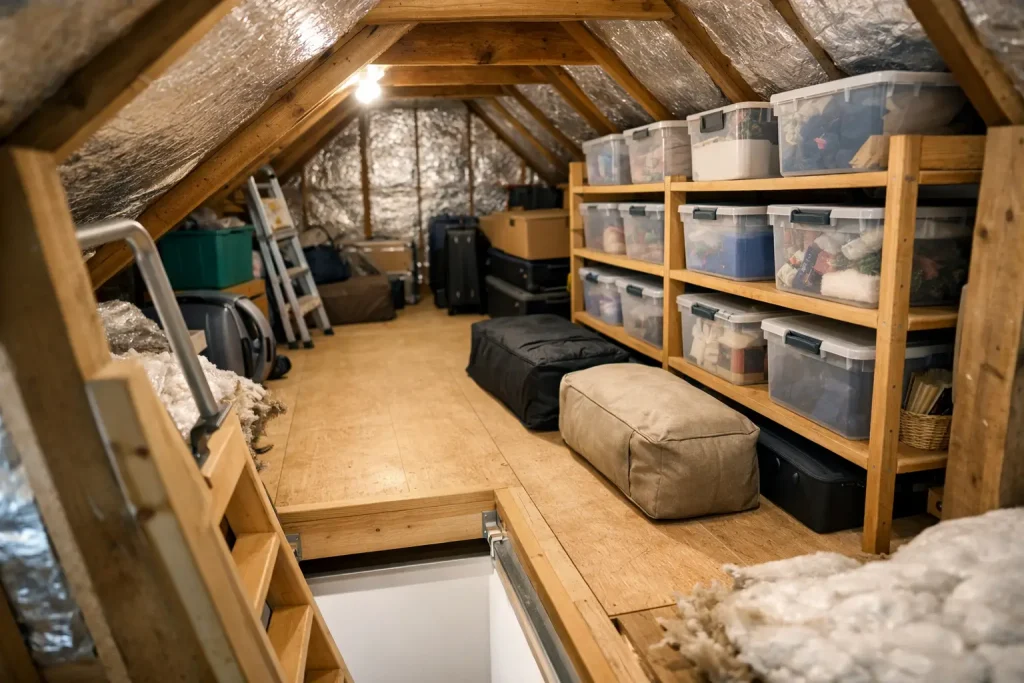
The loft is often where good intentions go to gather dust. Christmas boxes, suitcases, baby clothes, paperwork you cannot quite part with – it all ends up overhead, usually balanced on joists, reached by a wobbly stepladder, and packed around insulation that should really be left alone. That is why loft storage Milton Keynes homeowners choose tends to be less about squeezing in a few more boxes and more about making the space safe, practical and worth using.
A well-planned loft storage area should do three jobs at once. It should give you dependable storage, protect the insulation that keeps heat in the home, and make access simple enough that you will actually use it. If one of those elements is missing, the loft quickly goes back to being awkward, risky or wasteful.
What good loft storage in Milton Keynes really means
Many people picture loft storage as a few boards laid across the top and a hatch that is just about manageable. In reality, that approach often creates problems. Standard boarding placed directly on top of insulation can compress it, reducing its thermal performance. Poor access makes the space harder to use. And if the area is not designed properly, storing heavier items can become a safety concern.
Good loft storage is a complete system rather than a single product. It starts with understanding how your loft is built, how much insulation is already in place, and what you actually need to store. A family using the loft for seasonal items needs a different solution from someone wanting regular access for household storage every week.
That is where specialist advice matters. A clear survey and written quote remove the guesswork. You know what is suitable for your home, what is not, and why.
Why raised loft boarding matters
The detail that makes the biggest difference is often the one most homeowners cannot see once the job is finished. Raised loft boarding creates a storage platform above the insulation rather than crushing it underneath. That matters because insulation only works properly when it keeps its depth and structure.
If boarding is fitted directly onto the joists in a loft with modern insulation standards, there is usually not enough height to do the job properly. Something has to give, and too often it is the insulation. The short-term gain is a flatter surface. The long-term downside can be a colder home and higher heating costs.
Raised systems avoid that trade-off. They let you keep the insulation depth needed for energy efficiency while still creating a stable boarded area for storage. For newer homes, this is especially important. Using NHBC-approved loft legs help ensure the boarding is raised correctly and support the conditions of the property warranty.
For many households, that combination of storage and thermal performance is the real value. You are not just tidying away clutter. You are improving how the house works.
Loft storage Milton Keynes homes often need more than boards
One of the most common issues is access. Even a well-boarded loft is of limited use if getting into it feels like a chore. Small hatches, awkward openings and unreliable ladders turn simple storage into something people put off.
A proper loft ladder and suitable hatch access change that immediately. Instead of dragging out steps and hoping for the best, you get safe, straightforward entry to the space. That is especially useful for busy families, older homeowners, or anyone who wants to use the loft regularly without hassle.
There is no single answer for every property. Some homes have enough room for a standard hatch upgrade, while others need a more considered access solution. The right choice depends on the layout of the landing, ceiling height and how often the loft will be used. A good installer will explain the options plainly and recommend what suits the house rather than overselling.
The link between loft storage and lower energy bills
Storage is usually the reason people start looking at the loft, but insulation is often the reason they feel the benefit afterwards. Heat loss through the roof is a real issue in many homes, particularly where insulation is old, patchy or disturbed by years of ad hoc storage.
When storage and insulation are planned together, the result is far better than treating them as separate jobs. The loft becomes usable without sacrificing warmth. In practical terms, that can mean rooms below feel more comfortable in winter and the heating does not need to work as hard.
Of course, the exact savings vary from one home to another. Property age, existing insulation levels and heating habits all play a part. But the principle is straightforward – if your loft is losing heat, improving it properly can reduce that loss. Done well, loft storage is not just about space. It can be a sensible step towards a more energy-efficient home.
Why specialist installation makes a difference
There is a clear difference between a general home improvement service and a company that works on lofts day in, day out. Lofts come with their own constraints – limited head height, hidden services, insulation requirements, structural considerations and access challenges. It pays to use someone who understands those details thoroughly.
A specialist is also more likely to give honest guidance on what your loft can realistically do. Not every loft should be fully boarded wall to wall. In some homes, a partial storage area is the right answer. In others, improving access first makes more sense than adding more boards. Straightforward advice saves money and avoids disappointing results.
Homeowners also tend to value the practical side of the service just as much as the technical work. Turning up when promised, protecting the home while work is carried out, completing the job neatly and leaving the area tidy all matter. When you are trusting someone to work in your house, reliability is not a small extra. It is part of the service.
What to expect from a professional loft storage survey
A proper survey should feel informative, not pressured. The aim is to assess the space, understand how you want to use it, and recommend a solution that fits the property. That includes looking at the loft structure, insulation levels, access, hatch size and any limitations that need to be considered from the start.
This is also the stage where pricing should be made clear. A detailed written quote gives you confidence that the work has been properly assessed and costed, rather than guessed at over the phone. It also helps you compare like for like if you are speaking to more than one provider.
For local homeowners, working with a family-run specialist can make the process feel more straightforward. The advice tends to be practical, the communication clearer, and the job more focused on getting the result right rather than fitting you into a one-size-fits-all package.
Choosing loft storage that suits the way you live
The best loft storage solution is not necessarily the biggest one. It is the one that suits your household. Some people want a safe place for archives, decorations and keepsakes. Others are trying to free up an airing cupboard, a spare room or the top of every wardrobe. A growing family may simply need more room without losing living space elsewhere in the home.
That is why it helps to think beyond square metres of boarding. Consider how often you will access the loft, what you plan to store, and whether the current insulation is helping or hindering the comfort of the rooms below. A thoughtful design takes all of that into account.
For homeowners in and around Milton Keynes, this kind of work is often one of the most practical upgrades available. It makes use of space you already have, avoids unnecessary disruption, and can improve both storage and energy performance at the same time. Companies such as Loft Accessories focus on exactly that sort of specialist, well-planned installation.
The best time to sort the loft is usually before another winter passes or another year of clutter builds up. A loft that is safe, accessible and properly insulated gives back a little bit every day – in easier storage, a tidier home and a house that feels warmer when it matters.