
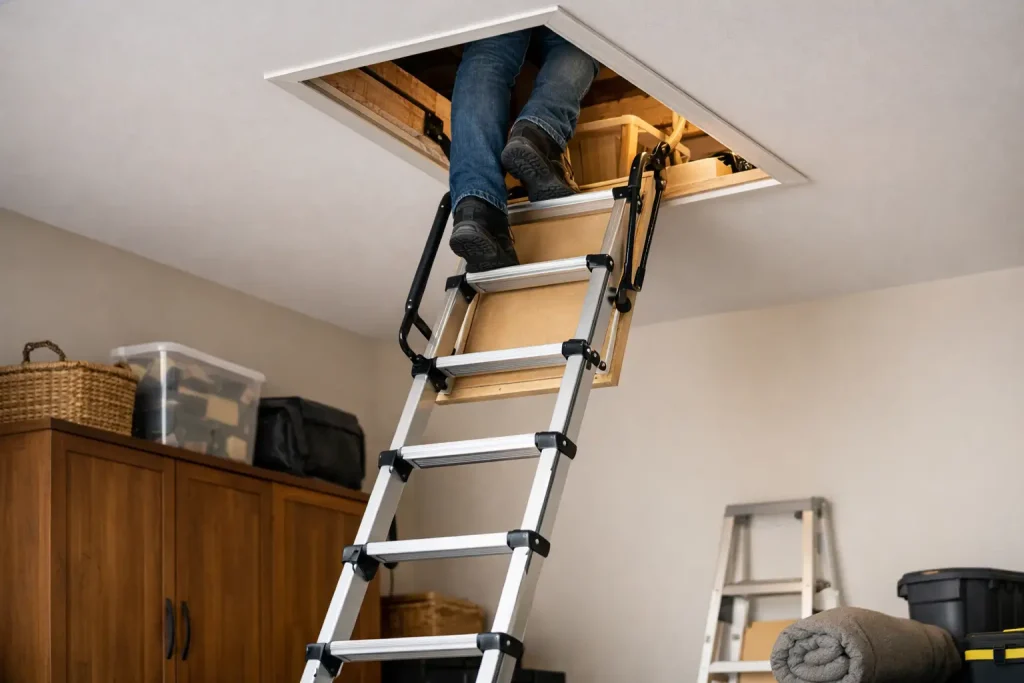
A loft that is difficult to reach soon becomes a loft that is barely used. Boxes get left where they should not be, seasonal items take over bedrooms and accessing storage can feel unsafe. This loft ladder buying guide explains what to look for before choosing a ladder, so your loft becomes a practical, secure part of the home rather than wasted space overhead.
The right choice is not simply about finding a ladder that fits through the hatch. It needs to suit your ceiling height, the available room below, the amount you intend to carry and the condition of the loft itself. Safe access, proper insulation and a solid storage area work best when planned together.
Start with the loft hatch and available space
The loft hatch sets the starting point for almost every ladder decision. Its length and width determine which ladder styles can be fitted, while the space around it affects how comfortably the ladder can be operated. A narrow hatch may need enlarging before a suitable ladder can be installed safely.
Also consider the landing or room below. A folding loft ladder needs clear floor space when open, whereas a sliding or concertina design can be useful where space is more limited. The ladder should not open across a door, block a main walkway or create an awkward obstruction on a busy landing.
Ceiling height matters just as much. Most loft ladders are made for a defined range of floor-to-ceiling heights. Choosing one outside that range can leave it at the wrong angle, which affects both comfort and stability. A professional survey takes these measurements accurately and checks that the access arrangement works in everyday use.
Choose a ladder style that suits how you use the loft
There is no single best loft ladder for every home. The sensible choice depends on how often you need access and what you will be carrying.
Folding timber ladders
Timber folding ladders are a popular option for regular household storage. They provide broad, comfortable treads and a familiar feel underfoot, making them well suited to carrying boxes, suitcases and Christmas decorations. A well-fitted timber ladder can also offer a sturdy, dependable solution for family homes.
They generally need more hatch space than compact alternatives, so they are not always the answer in tight locations. Good installation is essential, particularly where the hatch opening has to be altered to accommodate the ladder correctly.
Aluminium sliding and folding ladders
Aluminium ladders are light, durable and straightforward to operate. They can be an excellent fit where a homeowner wants regular loft access without a heavy ladder to manage. Many models fold neatly into the hatch, while sliding versions can work well where headroom or hatch dimensions make a folding arrangement less suitable.
The trade-off is often tread depth. Some aluminium ladders have narrower rungs than timber models, which may be less comfortable if you visit the loft frequently or carry larger items. A handrail can make a considerable difference to confidence and safety.
Concertina ladders
Concertina ladders are designed for compact spaces. They fold away efficiently and can be useful where the hatch is small or the floor area beneath is restricted. Their space-saving design is their main advantage.
However, they are usually better for occasional access than frequent trips with bulky storage. Their narrower steps and steeper feel may not suit every household. The best option should make loft access easier, not merely possible.
Check load rating, treads and handrails
A loft ladder must safely support the user and anything being carried. Always consider the manufacturer’s stated load rating, but think beyond a single person’s body weight. Luggage, archive boxes, bedding and storage containers all add weight, and it is sensible to allow a comfortable margin.
Look for treads that offer secure footing. Wider, non-slip treads are particularly helpful when carrying items or using the ladder in socks, although sensible footwear is always safer. The ladder should feel stable at the bottom and sit correctly against the floor when extended.
A handrail is not an unnecessary extra. It provides a reliable point of contact as you move between the landing and the loft, which is where many people feel least steady. For homes where children, older relatives or anyone with reduced mobility may use the ladder, this feature deserves serious consideration.
Do not overlook the hatch and insulation
A new ladder is often fitted as part of a complete hatch and access solution. This is worth considering because an old, loose-fitting hatch can allow warm air to escape into the loft. The result can be draughts, cold rooms below and higher heating costs.
An insulated loft hatch helps keep the thermal barrier continuous. It should close neatly, be properly sealed and be fitted without compromising the surrounding ceiling. This is especially relevant when the loft insulation has been upgraded, as access points should not become the weak spot in an otherwise energy-efficient loft.
The loft itself also needs adequate insulation. If boarding is planned, it should be raised above the insulation rather than compressing it. Compressed insulation cannot perform as intended, which can reduce the comfort and energy-saving benefits you expect from the work.
Think about the route into the storage area
Getting through the hatch is only the first part of safe loft access. Once inside, you need a stable place to step and a clear route to the storage area. Stepping directly onto ceiling joists or insulation is not a safe or practical long-term arrangement.
A properly boarded access route and storage platform make a real difference. They allow you to move items in and out with confidence while protecting insulation below. In newer properties, raised boarding systems using NHBC approved loft legs can preserve the required insulation depth and help protect the home’s warranty conditions.
It is also worth considering lighting. A simple, well-positioned loft light makes storage easier to organise and reduces the risk of missteps. The aim is a loft that works calmly and safely whenever you need it, not one that requires a balancing act each time.
Ask about fitting, not just the ladder itself
A good ladder can still perform poorly if it is fitted incorrectly. The hatch frame must be secure, the ladder must open and close smoothly, and all fixings need to be suitable for the structure around the opening. Small details, such as whether the hatch closes flush and whether the ladder reaches the floor correctly, affect the finished result every day.
It is sensible to ask what is included in the quotation. Does it cover the ladder, hatch, insulation, handrail, boarding adjustments and removal of old materials? Clear written pricing helps avoid surprises and lets you compare like for like.
A survey is particularly valuable in properties with limited landing space, unusual ceiling heights or older loft structures. Rather than selecting a product from a photograph, you can understand what will suit your home, why it is recommended and what the completed access will look like.
A practical loft ladder buying guide checklist
Before making a decision, make sure the proposed solution answers four straightforward questions: does it fit the hatch and ceiling height, is there enough clear space to use it, will it support regular access and stored items safely, and does it protect the loft’s insulation performance?
If the answer to any of these is uncertain, it is worth pausing before choosing. The cheapest ladder is not always the best value if it is uncomfortable to use, poorly insulated around the hatch or unsuitable for the storage you need.
For homeowners in Milton Keynes and the surrounding area, a friendly, professional survey can turn those questions into a clear plan. Loft Accessories can assess your access, storage and insulation needs together, then provide straightforward advice and a detailed written quote. A properly chosen ladder should make reaching your storage feel simple, safe and reassuring for years to come.