
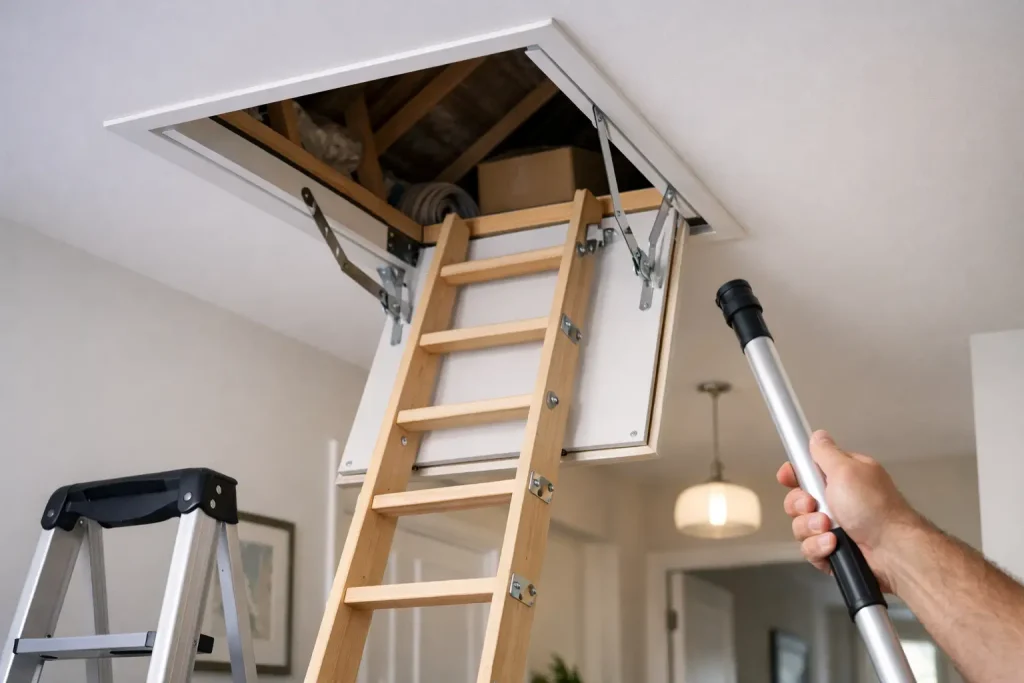
A loft hatch tends to get ignored until you need it. Then suddenly it matters a great deal – whether you are balancing bags of decorations on a stepladder, struggling with a draughty old opening, or realising the hatch is too small for sensible storage. If you are wondering how to choose loft hatch access, the right answer usually comes down to safety, ease of use and how you want the loft to work day to day.
For most homeowners, this is not about adding complexity. It is about making loft space practical. A well-chosen hatch access setup should let you get into the loft comfortably, protect warmth in the home below, and make storage feel straightforward rather than awkward.
How to choose loft hatch access for your home
The first thing to look at is how often the loft will be used. If you only need occasional access for light storage, one type of hatch and ladder may be perfectly suitable. If you expect to use the loft regularly, perhaps for seasonal items, family keepsakes or household overflow, the access needs to feel secure and easy every single time.
That is where many people go wrong. They focus on the opening alone, when the full setup matters more. Loft hatch access is really a combination of the hatch size, the position of the opening, the ladder arrangement, the clearance below, and the insulation value of the hatch itself. If one part is poorly suited to the house, the whole thing becomes inconvenient.
A smaller hatch may technically provide access, but it can make lifting boxes awkward and limit what you can store. A larger hatch often improves usability, but only if there is enough room on the landing or in the ceiling area to install it properly. The best option depends on the property layout, ceiling structure and how the loft is intended to be used.
Start with safety, not just convenience
Safety should be the first filter when choosing any loft hatch access. Old hatches often rely on a loose panel and a separate stepladder, which is not ideal for regular use. Even if that setup has been in place for years, that does not make it safe or comfortable.
A proper loft ladder changes the experience immediately. It gives stable access, reduces the chance of slips, and makes it far easier to carry lighter items up and down with confidence. The ladder itself needs to suit the available height and the room below. Some homes benefit from a compact folding ladder, while others have space for a sliding or concertina style. There is no single best answer for every property.
Headroom also matters. A hatch that opens into a cramped spot can be frustrating and unsafe, even if the ladder is good quality. Likewise, if the landing below is narrow or sits close to a door swing, the access may need more careful planning. This is where a professional survey is useful because it looks at how the hatch works in real life, not just on paper.
Hatch size makes a bigger difference than most people expect
One of the most common problems with older loft access is a hatch that is simply too small. You can still get into the loft, but using the space becomes awkward. Larger storage boxes do not fit through easily, and even moving around the opening can feel restrictive.
When thinking about how to choose loft hatch access, ask yourself what needs to pass through the opening. If the answer is only a torch and the Christmas tree, a modest hatch may do. If you want proper, usable storage, a larger opening is usually worth considering.
That said, bigger is not automatically better. The hatch must be installed in a suitable position and finished neatly, with attention paid to the surrounding ceiling and insulation. In some homes, the ideal result is not the largest possible hatch, but the largest practical one that works safely and cleanly within the structure.
Insulation matters as much as access
A loft hatch is not just an entry point. It is also part of your home’s thermal envelope. If the hatch is poorly fitted or uninsulated, it can allow warm air to escape and colder air to enter, which is the last thing you want with energy prices where they are.
This is why modern insulated hatches are such a sensible upgrade. They help reduce draughts, improve comfort on the floor below and support the performance of the loft insulation overall. Even a well-insulated loft can lose efficiency if the hatch remains the weak spot.
Good loft hatch access should never mean sacrificing warmth. In fact, done properly, it should support a more energy-efficient home. For many households, that is a major part of the value – not just easier storage, but lower heat loss and a better-performing house.
Think about the ladder and hatch as one system
People often ask whether they need a new hatch or just a ladder. In practice, the two usually work best when considered together. A new insulated hatch paired with the right integrated ladder tends to give a neater, safer and more reliable result than trying to improve one element while leaving the other behind.
The right ladder depends on how the space below is used. In a tighter landing area, a compact ladder may be the better fit. In a larger hallway, there may be more flexibility. Weight capacity, ease of opening and closing, and how steady the ladder feels underfoot all matter.
This is particularly important for families and long-term homeowners who expect to use the loft for years to come. Access should not feel like a struggle. If you hesitate every time you need to go up there, the setup is not really doing its job.
Older homes and newer homes need different considerations
Property age can influence the best choice. In older homes, loft hatches are often smaller, less insulated and placed with little thought for practical storage. The surrounding structure may need careful assessment before enlarging the opening or fitting a modern ladder system.
In newer homes, the conversation is often about protecting what is already there while improving access and storage. That includes making sure loft solutions work properly with insulation levels and, where relevant, with the requirements of the home’s warranty. For example, when loft boarding is added later, the installation should avoid compressing insulation and should be completed in a way that respects the property’s construction details.
That is why specialist advice matters. A loft access upgrade is not just a joinery job. It needs to work with the loft as a whole.
Practical questions that help you choose well
A good way to narrow down the right option is to ask a few simple questions. How often will the loft be used? What will you store there? Is the current hatch awkward, draughty or too small? Does the landing give enough room for a ladder to operate safely? Would a better-insulated hatch help improve comfort in the home?
The answers quickly point towards the right setup. Some households need a straightforward hatch replacement with better insulation. Others benefit from widening the opening and fitting a ladder that makes regular access much easier. The right recommendation should feel proportionate to the home and to how you actually live.
If a quote feels vague, that is usually a warning sign. You want clear advice, written pricing and a proper explanation of what is being fitted and why. Good loft specialists will talk you through the trade-offs, not just push the biggest option.
How to choose loft hatch access without overcomplicating it
The simplest way to approach how to choose loft hatch access is to think in terms of outcome. You want access that is safe, easy to use, properly insulated and suitable for the amount of storage you need. That rules out a surprising number of poor choices straight away.
You also want the finish to be neat. A loft hatch sits within the home, not hidden away in a garage. It should open and close cleanly, sit well in the ceiling, and feel like part of the house rather than an afterthought. Small details make a difference here, especially in hallways and landings that are used every day.
For homeowners in and around Milton Keynes, Bedford, Northampton or Oxford, another practical point is choosing a firm that focuses on loft access and storage rather than treating it as a side service. Specialist experience usually shows in the survey, the recommendation and the quality of the finished job.
Loft Accessories often sees the same issue repeated across different properties – a loft with useful potential, held back by poor access. Once the hatch and ladder are sorted properly, the space becomes far more useful and the whole house feels easier to organise.
A good loft hatch access solution should feel ordinary in the best possible way. No wobble, no draught, no awkward climb, no second thought every time you need something from the loft. If the setup gives you safe access, protects your insulation and makes storage genuinely usable, you have chosen well.