
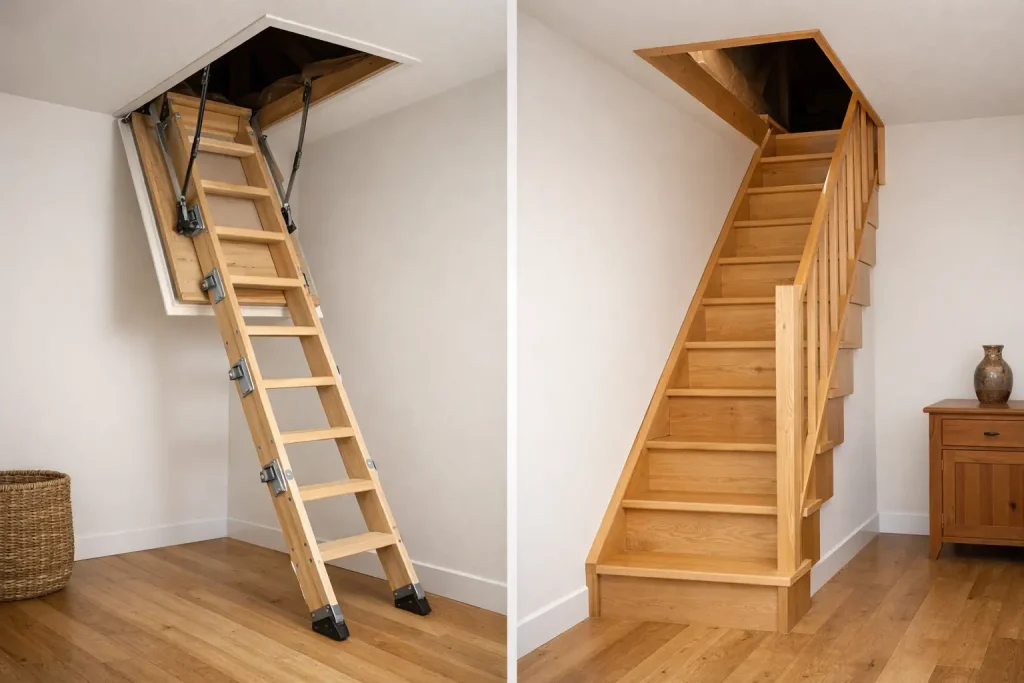
A loft that is hard to reach rarely becomes useful storage. Boxes get left on the landing, seasonal items never make it back upstairs, and each trip up feels less safe than it should. When weighing up a loft hatch ladder vs loft stairs, the right choice comes down to how you use the space, the room below and the access your property can accommodate.
For most homes, a properly fitted loft hatch and ladder provides the practical, space-saving answer. Stairs can be a good option in particular circumstances, but they demand far more floor space and structural consideration. A clear survey of the loft and landing helps ensure you spend money on access that genuinely makes everyday life easier.
Loft hatch ladder vs loft stairs: the main difference
A loft hatch ladder is a retractable ladder fitted into or beside an enlarged, insulated loft hatch. It folds or slides away when not in use, keeping your landing clear while giving you reliable access whenever you need it. Modern ladders are available in several styles, including timber folding, aluminium folding and telescopic designs.
Loft stairs are a fixed staircase leading from the floor below into the loft. They are always in place and usually feel more familiar underfoot, particularly for people who find ladders uncomfortable. However, a staircase requires a substantial permanent opening and takes up valuable room on the floor below as well as space in the loft.
Neither option is automatically better. The sensible choice is the one that provides safe access without compromising the layout, warmth or everyday use of your home.
Why a loft ladder suits most storage spaces
For homeowners using the loft for suitcases, Christmas decorations, paperwork, children’s keepsakes or occasional household storage, a hatch ladder is normally the most sensible solution. It provides access when needed but does not claim a section of the landing, bedroom or hallway all year round.
A well-selected ladder should feel stable, be the correct length for your ceiling height and have a safe working load suited to the items being carried. Handrails and wide treads can make a noticeable difference to confidence on the ladder, especially where access is used regularly. The hatch itself also matters. An outdated or poorly fitting hatch can allow warm air to escape into the loft, so an insulated replacement hatch helps protect the thermal performance of the home.
There is another practical benefit: a specialist can position or enlarge the hatch to work with the available joists and the most useful area of boarded storage. This can turn an awkward, limited opening into a safe route to a tidy, accessible platform.
Space-saving access for busy homes
A folding loft ladder is stored within the hatch area. A sliding or telescopic ladder uses even less clearance in some properties, although the best type depends on the available loft height and headroom. The aim is not simply to fit a ladder in. It is to allow you to climb up and down comfortably without negotiating a cramped landing or an unsuitable angle.
For families and working households, this often makes the difference between a loft that is technically accessible and one that is genuinely useful. When putting storage away is straightforward, it is far easier to keep bedrooms, cupboards and living areas clear.
Protecting insulation and storage space
Access should be considered alongside insulation and loft boarding, not as a separate job. If the loft is insulated to modern recommended levels, boarding needs to be raised above it rather than compressing the insulation beneath. Compressed insulation is less effective, which can affect warmth and heating costs.
In newer homes, NHBC approved loft legs can create a raised storage platform while helping to preserve the performance of the insulation. Good access then allows that storage area to be used safely, without balancing on joists or disturbing the insulation every time you need a box.
When loft stairs may be worth considering
Fixed stairs can make sense where the loft is used very frequently and the property has enough room to accommodate them properly. They remove the need to unfold a ladder and can be easier for carrying lighter, bulky belongings. For someone who needs to go up and down often, that convenience may be appealing.
The trade-off is significant. A staircase needs a generous footprint, a suitable route from the floor below and adequate headroom. In many homes around Milton Keynes, Northampton and the surrounding towns, the landing space is simply not available without making the first floor feel tighter or disrupting an existing room layout.
Stairs may also reduce the amount of usable storage area near the loft entrance. Their opening takes up more of the floor structure, and the stairwell itself can create awkward areas around it. The work is therefore more involved than fitting a hatch and ladder, with greater impact on the home and typically a higher overall cost.
It is also worth thinking about whether permanent stairs solve a real problem. If you use the loft only once or twice a month, they can be an expensive use of space for convenience you may rarely need. A sturdy, professionally fitted ladder with handrails often delivers the safer, easier access homeowners are looking for without that compromise.
Safety should lead the decision
The most important question is not whether a ladder or stairs looks more impressive. It is whether the access can be used confidently and safely by the people who will use it.
For a loft hatch ladder, this means a secure installation, appropriate ladder angle, reliable locking mechanism and a hatch opening large enough to pass through without awkward twisting. It should also open into a clear area below, rather than over a narrow section of landing where someone could step straight into a door or wall.
For fixed stairs, safe use depends on their pitch, headroom, handrails and how naturally they fit into the home. A staircase that is squeezed into an unsuitable space can be inconvenient and uncomfortable, even if it appears to offer easier access on paper.
The items you intend to store matter as well. Heavier or cumbersome belongings should be reduced where possible and handled carefully. No access solution changes the need to use sensible lifting techniques, but stable access and a properly boarded route make the job much more manageable.
Cost, disruption and long-term value
A loft hatch ladder generally involves less disruption than stairs. Installation can often be planned around the existing structure, with the work focused on the hatch opening, ladder, insulation and a neat finish. Where boarding and insulation are being improved at the same time, combining the work can make the whole project more efficient and ensure each element works together.
Stairs require a more extensive alteration to the home. Aside from the initial outlay, consider the permanent loss of floor area below. A larger house may absorb this easily; in a typical three-bedroom property, that space can be more valuable as part of a landing or bedroom.
Long-term value is not only about the initial price. A neat, insulated hatch, dependable ladder and safely boarded storage area can improve how the entire home functions. You gain somewhere practical for the possessions you need to keep, while protecting insulation that helps the property retain heat.
Questions to ask before choosing
Before deciding, consider how often you will use the loft, who needs access and what needs to be stored there. Look honestly at the room below the hatch: can it spare the footprint of fixed stairs, or would that make the space less useful? Also check whether the existing hatch is large enough and whether the loft has a safe boarded route from the entrance to the storage area.
A professional survey is valuable because the answer is often found in details homeowners cannot easily see from below. Joist direction, available headroom, insulation depth, hatch position and the layout of the first floor all influence what will work well. It also gives you the chance to receive a clear written quote rather than relying on assumptions.
Loft Accessories takes this practical approach during free home surveys, recommending access that suits the property rather than pushing a one-size-fits-all option. The work should leave you with a tidy finish, reliable access and confidence that your loft is ready to earn its keep.
The best access solution is the one you will feel comfortable using on an ordinary Tuesday evening, not just the one that sounds good in theory. Choose an insulated, well-fitted hatch ladder where it provides all the access you need, and reserve fixed stairs for homes where frequent use and available space genuinely justify them.