
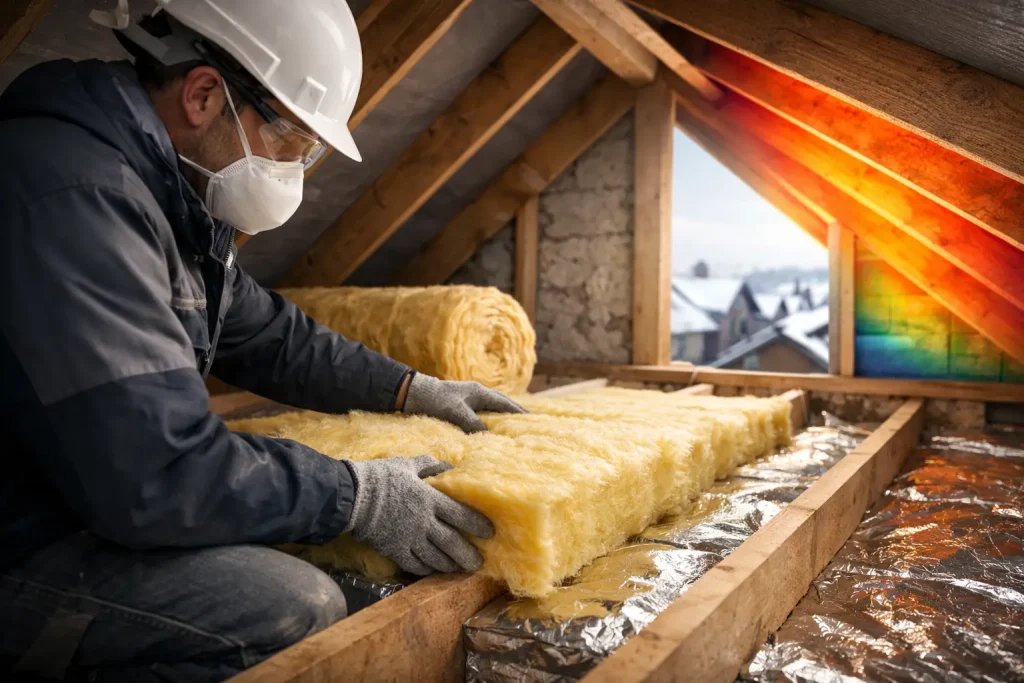
If your upstairs rooms cool down quickly or your heating seems to work harder than it should, the loft is often the first place to look. Knowing how to reduce attic heat loss is less about one quick fix and more about making sure the whole space works as it should – insulation, access, storage and ventilation all need to support each other.
Many homeowners are surprised to find that their loft already has insulation, yet the house still feels chilly in winter and costly to heat. That usually comes down to gaps, compressed insulation, poorly sealed hatches or boarding laid directly on top of the insulation. The loft may look finished, but its thermal performance can still be letting the rest of the house down.
How to reduce attic heat loss without wasting money
The most effective approach is to start with the areas that cause the biggest losses. In most homes, that means the loft floor insulation, the loft hatch and any points where warm air from the house below is escaping into the attic.
Heat rises, but it does not only disappear through bare plasterboard. It also slips through small gaps around pipework, cables, downlights and poorly fitted hatches. These details matter because even good insulation will underperform if warm indoor air is constantly leaking into a cold loft.
It is also worth saying that more insulation is not always the full answer on its own. If insulation is squashed under storage boards, if ventilation is blocked, or if access is awkward and unsafe, the loft can become a problem area rather than a practical asset. The best results come from a specialist view of the whole space.
Start with the insulation depth and condition
In many older properties, the insulation level is simply below modern expectations. A thin layer that may have been acceptable years ago will not do much to hold heat in by current standards. Topping up insulation to the correct depth often delivers one of the clearest improvements in comfort and energy efficiency.
Condition matters just as much as depth. Insulation that is patchy, damp, disturbed or flattened will not perform properly. This is common in lofts that have been used for storage without a raised system in place. Boxes get moved around, insulation gets pressed down, and the thermal barrier becomes uneven.
Mineral wool remains a common and effective choice for many homes, but it needs to be laid correctly and continuously. Gaps around the eaves, awkward corners or service runs can create weak spots where heat escapes. A tidy, complete installation tends to outperform a thicker layer that has been fitted badly.
For homeowners thinking about storage as well as energy savings, this is where planning matters. If you want a usable loft, the insulation and the storage platform should work together rather than competing for the same space.
Raised loft boarding helps protect insulation performance
One of the most overlooked answers to how to reduce attic heat loss is raising the boarding above the insulation instead of laying boards directly on top of it. When insulation is compressed, it loses much of the trapped air that helps it slow heat transfer. That means you can have a boarded loft and still be losing warmth through the ceiling below.
A properly raised boarding system creates a stable storage area while allowing the insulation to remain at its intended depth. This is especially important in newer properties, where using the right system can also help protect the terms of an NHBC warranty. For many homeowners, that balance of storage, access and thermal efficiency is what makes the loft genuinely useful.
This is one of those areas where cutting corners often costs more later. Cheap boarding methods can look fine at first glance, but if they flatten the insulation, the result is reduced energy performance and a loft that is less efficient than it should be.
Do not ignore the loft hatch
A poorly fitted loft hatch can undo some of the benefit of good insulation. Warm air naturally finds the easiest route out, and an uninsulated or draughty hatch is often one of them. If you can feel cold air around the hatch or notice condensation nearby, it is worth addressing.
An insulated loft hatch with effective draught sealing helps reduce heat movement between the house and the loft. It also improves comfort on the landing, which is often where people first notice a cold spot. If the hatch is old, ill-fitting or difficult to use, replacing it can improve both heat retention and everyday access.
This is particularly relevant in homes where the loft is rarely used because access is awkward. When a hatch and ladder are safe and easy to use, the loft is more likely to stay organised, and the insulation is less likely to be disturbed by awkward, makeshift access.
Air leakage is often the hidden problem
Insulation slows heat transfer, but draught-proofing stops warm air escaping in the first place. The two work together. If air leakage is left untreated, warm air from the rooms below can pass into the loft, carrying heat and moisture with it.
Typical leakage points include pipe penetrations, cable holes and gaps around fittings. In some homes, recessed lights are a particular issue. If the loft has been insulated but still feels inefficient, these smaller openings may be the reason.
The right treatment depends on the layout and age of the property. Some gaps can be sealed quite simply, while others need more careful consideration so ventilation is not affected. That balance is important. You want to reduce uncontrolled heat loss, not trap moisture where it should be allowed to disperse safely.
Ventilation still matters
When people think about keeping heat in, they sometimes assume the loft should be sealed up as tightly as possible. In reality, the living space below should be well sealed from the loft, while the loft itself usually still needs appropriate ventilation.
Good ventilation helps manage moisture and reduces the risk of condensation, which can affect insulation performance and lead to timber problems over time. Blocking eaves ventilation with insulation is a common issue in poorly planned installations. So is boarding in a way that interferes with airflow.
This is why loft work should never be treated as a single-product job. Insulation, boarding and ventilation all affect each other. When one part is handled badly, the whole system suffers.
Storage can either help or hinder energy efficiency
Most homeowners are not looking at the loft purely as a thermal zone. They want useful storage too. That is completely reasonable, but the way the storage is created makes all the difference.
A cluttered loft with loose boards balanced across joists often leads to disturbed insulation, blocked airflow and wasted space. By contrast, a properly designed raised boarding area keeps belongings secure without undermining insulation depth. It also makes the loft easier to use safely and tidily.
That practical benefit matters because a loft that works well tends to stay in better condition. People are less likely to crush insulation, overfill awkward corners or avoid the space entirely. A good setup supports the daily realities of family life as much as it supports lower heating bills.
Older homes and newer homes need slightly different thinking
The basic principles are the same, but the right solution can vary by property. Older homes may have uneven joists, outdated insulation or more obvious draught paths. Newer homes often already have insulation, but the issue is poor boarding practice or limited accessible storage.
In a newer property, protecting the performance of the insulation without compressing it is often the key priority. In an older property, there may be more benefit in upgrading insulation levels and dealing with obvious heat leakage points at the same time. That is why a proper survey is useful – it helps avoid paying for work that sounds sensible but does not solve the real problem.
Professional installation makes the difference
There is a clear difference between having materials in the loft and having the loft set up properly. The quality of fitting, the choice of system and the way each part of the space works together all affect the result.
For homeowners in Milton Keynes and surrounding areas, this is where using a loft specialist can make things much simpler. A clear survey, honest advice and a written quote help you understand whether the problem is insufficient insulation, compressed insulation, poor access, a draughty hatch or a combination of several issues.
At Loft Accessories, that practical approach is central to getting the job right. The aim is not to push unnecessary work, but to create a loft space that is safer to use, better insulated and more cost-effective to heat.
If you are wondering how to reduce attic heat loss, the best next step is usually to stop thinking of the loft as an empty void above the ceiling. When it is insulated properly, boarded correctly and accessed safely, it becomes part of a warmer, more efficient home rather than a place where your heating budget disappears.