
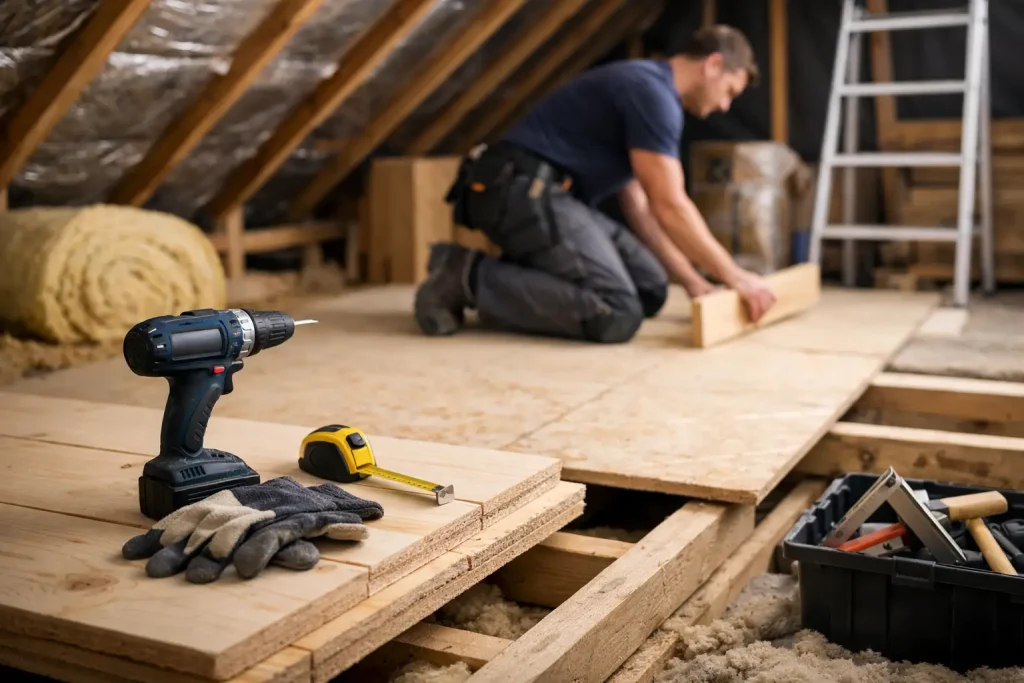
A loft can look like the obvious place to put the Christmas decorations, suitcases and boxes that have slowly taken over the spare room. But before boards go down, the space needs proper preparation. Knowing how to prepare loft for boarding helps protect your insulation, keep the area safe to use and avoid creating problems with heat loss, wiring or the roof structure.
The right preparation is not about filling every inch of the loft with flooring. It is about creating a stable, accessible storage area while allowing the loft to do its main job: helping to keep your home warm and dry. A professional survey is the sensible starting point, particularly in newer homes where insulation depth and warranty requirements need careful attention.
Start with a clear idea of what you need to store
The amount of boarding required depends on what the loft will be used for. Many households do not need a fully boarded loft. A well-planned central storage platform may be enough for labelled boxes, seasonal items and lighter belongings, leaving the rest of the loft untouched.
Think about weight as well as volume. Lighter household storage is very different from storing heavy books, furniture or large amounts of paperwork. Your installer can assess the joists and recommend a sensible boarding layout based on the intended use. This avoids paying for space you will not use and helps keep loading appropriate for the structure.
It is also worth sorting before any work begins. Old boxes, damaged decorations and items that have not been used in years do not need a permanent place in the loft. Reducing clutter first means the finished storage area can be organised properly from day one.
Check insulation before preparing a loft for boarding
Insulation is one of the most important considerations. Current loft insulation is commonly much deeper than older installations, which is good news for heat retention but means standard boards cannot simply sit directly on top of the joists. Compressing mineral wool insulation reduces its effectiveness, allowing more heat to escape through the roof.
The usual solution is to create a raised platform above the insulation. Raised supports, often called loft legs, are fixed to the joists and the boarding is installed on top. This preserves the full depth of insulation beneath while providing a firm surface for storage.
For homeowners in newer properties, this detail matters even more. NHBC approved loft legs are designed to raise the boarding without compressing insulation, helping to maintain the conditions of an NHBC 10-year warranty. It is a practical example of why loft boarding should be treated as a specialist job rather than an afterthought.
If the insulation is thin, uneven, damp or missing in places, address that before boarding is fitted. Improving insulation at the same time can make the home more comfortable and may help reduce heating costs. There is little value in installing a neat storage platform only to leave avoidable heat loss underneath it.
Keep ventilation routes clear
A cold roof loft needs ventilation to prevent condensation forming on timbers and the underside of the roof covering. When preparing the space, ventilation routes at the eaves must remain clear. Insulation should not be pushed into these areas, and boards should not block airflow.
Condensation is not always obvious at first. Over time, however, trapped moisture can lead to damp smells, mould and damage to roof timbers. A good installation balances insulation, boarding and ventilation rather than treating them as separate jobs.
Assess the loft structure and services
Before a board is fitted, the joists, roof timbers and existing services need to be checked. Loft joists are generally intended to support the ceiling below as well as limited stored items. They are not designed to carry unlimited weight, so a realistic view of the storage planned is essential.
The loft should also be inspected for signs of leaks, staining, timber damage or pest activity. These issues are best resolved before access becomes more restricted. Boarding over a problem does not make it disappear and can make future repairs harder.
Electrical cables deserve particular care. Cables covered tightly by insulation can overheat, while junction boxes should remain accessible for inspection. Pipes, tanks, extractor ducts and other services may also run through the loft. A tidy, planned layout keeps them protected and avoids boxing in components that could need attention later.
Where downlights are installed in the ceiling below, appropriate covers may be required before insulation is laid around them. This is one of several details that are easy to overlook but make a real difference to safety and performance.
Make access safe before you think about storage
A usable loft needs more than a boarded floor. If getting in and out involves balancing on a chair or carrying boxes up an unsuitable ladder, the space will soon become inconvenient and potentially unsafe.
Check the hatch size, its location and the headroom around it. A small hatch may be adequate for a quick inspection but frustrating when moving storage boxes. Enlarging the opening can provide more practical access, depending on the surrounding structure. A properly insulated hatch also helps prevent heat escaping through what is often a weak point in the ceiling.
The ladder should suit the household and the available space. A sturdy fitted loft ladder gives safer, more reliable access than a loose ladder, particularly for families or anyone who expects to use the loft regularly. The right option depends on ceiling height, hatch position and how much clearance is available below.
Lighting is equally useful. A simple, well-positioned loft light makes it easier to see where you are stepping, read box labels and spot any future issue such as a leak. It turns a dark void into a storage area you can use with confidence.
Choose boarding that suits the space
Good loft boarding is about secure fitting and sensible coverage, not simply laying as many boards as possible. Boards should be installed squarely on the raised support system, fixed securely and arranged to give a stable walking surface. Gaps around the edges may be needed to accommodate the shape of the loft and preserve access to services.
The best layout usually includes a clear route from the hatch to the storage platform. This reduces the temptation to step on unsupported areas or move across insulation. If the loft contains a water tank or equipment that needs occasional maintenance, leave a safe route to it as well.
Storage should be kept dry, clean and manageable. Use sturdy, labelled boxes with lids rather than loose bags, and avoid placing items directly against roof timbers or underneath the eaves where condensation risks can be greater. Spread items across the platform instead of piling heavy loads in one area.
Why a survey saves time and uncertainty
Every loft is different. The age of the property, joist arrangement, insulation level, roof design, hatch position and existing services all affect the right solution. That is why a survey is more useful than guessing from photos or measurements taken from below.
A specialist can explain what is practical, where boarding can go, whether insulation needs attention and what type of access will suit your home. You should receive a clear written quote that sets out the work, rather than being surprised by extras once the job is underway.
For homeowners across Milton Keynes and surrounding areas, Loft Accessories offers this straightforward approach: assess the loft properly, recommend only what is needed and complete the installation cleanly and safely. The aim is not to complicate a simple home improvement, but to make sure it is done properly the first time.
A prepared, raised and well-insulated loft gives your household useful breathing room without compromising warmth or safety. Once the work is complete, keep the area organised, avoid overloading it and treat it as practical storage rather than a place to forget everything. That way, the space remains useful for years rather than becoming another problem waiting overhead.