
The best loft access solutions are rarely the most complicated. For most homeowners, the right answer is the one that makes the loft safe to reach, easy to use and sensible for the way the house actually works day to day. If you are balancing growing storage needs, rising heating bills and a loft that feels awkward or unsafe, getting the access right changes everything.
A loft should not be a space you avoid because the hatch is too small, the ladder feels unsteady or the insulation has left nowhere practical to store anything. Good access turns wasted space into useful space. Just as importantly, it helps protect the energy performance of your home rather than working against it.
What makes the best loft access solutions?
There is no single answer that suits every property. The best loft access solutions depend on the age of the house, the height and position of the ceiling, the amount of loft storage you need and how often you plan to use it.
A hallway hatch used once every few months has different demands from a landing hatch that needs to cope with frequent access for suitcases, decorations and household storage. Some homes need the simplest upgrade to improve safety. Others need a more complete setup, where the hatch, ladder, boarding and insulation all work together properly.
That is often where homeowners get the best long-term value. A new ladder on its own may solve one problem, but if the hatch remains awkward or the loft floor cannot be used safely, the space still falls short.
Start with the loft hatch
The hatch is easy to overlook, yet it affects almost every part of loft access. Older hatches are often small, poorly fitted and not especially well insulated. They can make it difficult to lift items through, awkward to open and more likely to let warm air escape from the living space below.
A larger, properly fitted loft hatch can make a noticeable difference straight away. It improves access, gives better clearance for a ladder and makes the loft more practical for ordinary household storage. Where insulation and draught reduction matter, an upgraded hatch can also help limit heat loss.
The main trade-off is space. Some ceilings simply do not allow for a larger opening in the exact position you would prefer. That is why a proper survey matters. What looks simple from below may need careful planning above the ceiling, especially where joists, pipework or cables are involved.
Folding and sliding ladders
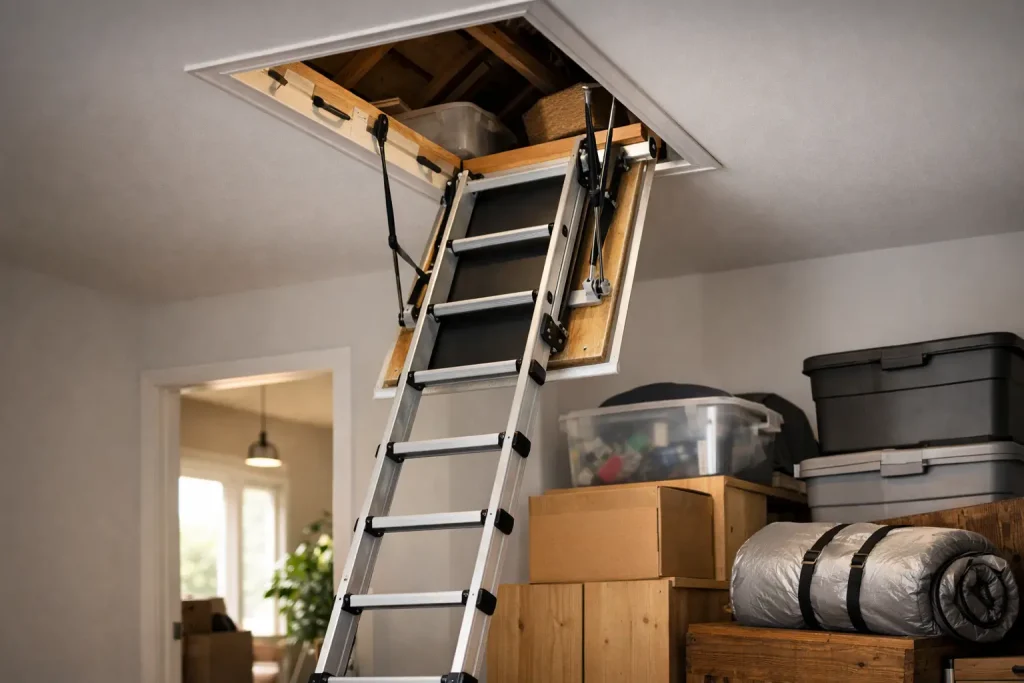
For many homes, a folding or sliding loft ladder is the most practical choice. It gives safe, straightforward access without taking up permanent room on the landing or in a bedroom. When fitted properly, these ladders are stable, easy to operate and much more convenient than balancing on an unsuitable setup.
Timber ladders often appeal to homeowners who want a solid, traditional feel. Aluminium options are popular too because they are lightweight and durable. Neither is automatically better in every case. It depends on the loft height, hatch size and how regularly the ladder will be used.
A compact ladder can be ideal in tighter spaces, but it still needs to feel secure underfoot. A heavier-duty model may suit busier family homes better, especially where the loft is used regularly for storage. The key is matching the ladder to the property and the user, not just choosing the cheapest option.
Loft boarding and access go together
Access is only half the job if the loft space itself is not usable. A safe ladder leading to exposed joists or compressed insulation does not give you a proper storage solution. That is why the best loft access solutions are often part of a wider plan.
Raised loft boarding is especially important in modern homes and in any property with substantial insulation depth. Boarding laid directly onto joists can squash the insulation, reducing its effectiveness. That can mean more heat escaping through the roof and less benefit from the insulation you have already paid for.
A raised system creates storage space above the insulation, helping you keep the thermal layer working as it should. In newer properties, this approach also matters for protecting warranty requirements. Using NHBC approved loft legs is a sensible way to create a secure boarded area without compromising the insulation below.
Best loft access solutions for energy efficiency
Many people think about loft access as a storage issue first, but energy efficiency should be part of the conversation. Heat rises, and a poorly fitted hatch or disturbed insulation can quietly chip away at the comfort of the home.
If your loft is difficult to enter, there is a fair chance the insulation has been left patchy, compressed or disrupted over time. Improving access often creates the opportunity to put that right. A better hatch seal, proper insulation depth and raised boarding can work together to make the house more comfortable and cheaper to heat.
This is where a specialist approach helps. General home improvement work can miss the way these elements affect each other. Loft access is not just about getting up there. It is about making the loft safe, practical and thermally efficient once you do.
Choosing the right setup for your home
A period property and a newer build will not usually need the same solution. Older homes may have awkward hatch positions, uneven loft spaces or limited headroom. Newer homes may have deeper insulation and stricter warranty considerations. In both cases, the best result comes from treating the loft as a whole system rather than a one-item purchase.
If access is only occasional, a simple ladder and hatch upgrade may be enough. If the loft is expected to take regular family storage, the job often needs more thought. The route into the loft, the safety of the climb, the stability of the flooring and the protection of the insulation all matter.
Homeowners are often pleasantly surprised by how much difference the right setup makes. What was once a dusty, awkward void becomes a genuinely useful part of the house. Not glamorous, perhaps, but very practical – and that counts for a lot in a busy home.
Why professional fitting matters
Loft access is one of those jobs where the finish matters just as much as the product. A well-made ladder or hatch can still disappoint if it is fitted poorly, feels flimsy or leaves untidy edges and gaps. The same goes for boarding that does not sit correctly or insulation that is disturbed in the process.
Professional fitting gives you a cleaner result, but more than that, it gives you confidence that the solution is appropriate for the property. Weight loading, clearance, hatch alignment and insulation protection all need to be considered properly.
For homeowners, peace of mind matters. Clear advice, a written quote and fully insured work are not extras. They are part of knowing the job will be handled properly from start to finish.
When a simple upgrade is enough – and when it is not
Sometimes the answer is refreshingly straightforward. If the loft already has good insulation, enough headroom and a sensible amount of usable space, a new hatch and ladder can transform access with minimal disruption.
In other homes, the awkward access is just the visible symptom of a bigger issue. A small hatch may be paired with poor insulation, no safe storage deck and nowhere stable to stand once inside the loft. In that case, choosing only one element can feel like a fix at first, but may not solve the day-to-day problem.
That is why honest recommendations matter. Not every loft needs the same level of work, and not every homeowner needs the most extensive option. The right advice should reflect how you use your home, what storage you need and what will give you lasting value.
A practical investment for busy households
For families and long-term homeowners, loft access tends to become more valuable over time. Seasonal items, keepsakes, baby equipment, luggage and paperwork all need somewhere sensible to live. When the loft is safe and easy to reach, it takes pressure off the rest of the house.
There is also the less visible benefit of doing the job properly. Better access often goes hand in hand with improved insulation performance and a tidier, more organised home. That combination can make everyday life easier while supporting lower heating costs.
In places such as Milton Keynes and the surrounding areas, where many homes have loft space with real storage potential, a well-planned access upgrade is one of the more practical improvements a homeowner can make. It is not about adding complexity. It is about making the space you already have work harder and work better.
If your loft is currently awkward, underused or simply not safe to access with confidence, the best next step is usually the simplest one – have the space assessed properly, understand the options clearly and choose a solution that suits your home for the long term.