
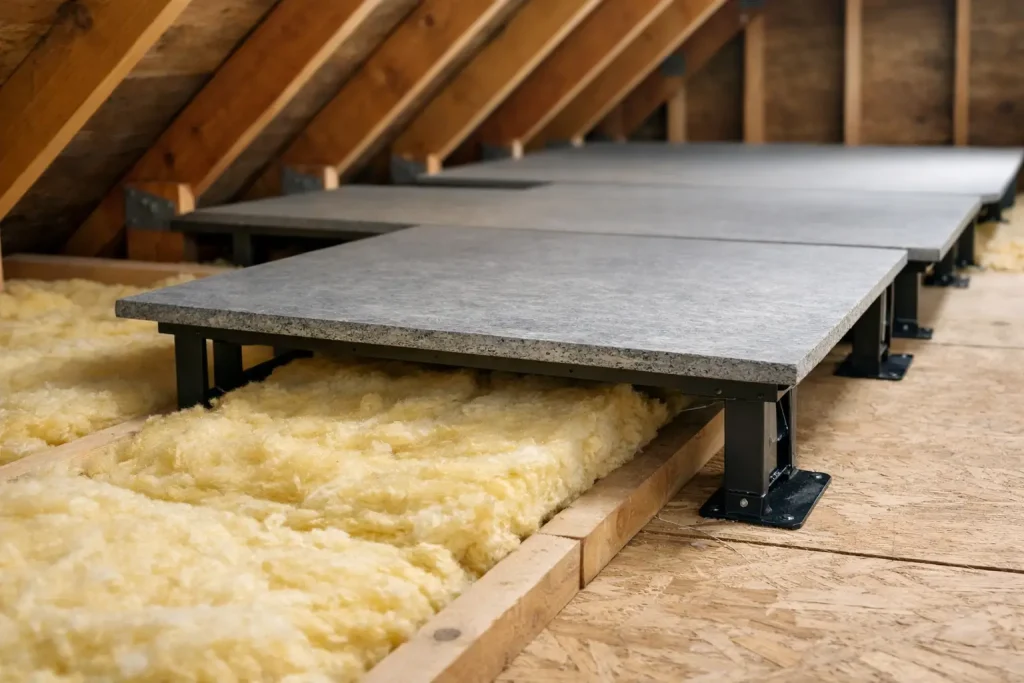
A loft can look like the perfect place to store suitcases, boxes and Christmas decorations – right up until the insulation gets squashed flat under ordinary boards. That is exactly why homeowners ask about how raised boarding protects insulation. The short answer is simple: it creates a storage platform above the insulation, so your loft remains usable without reducing the thermal performance that helps keep heat inside your home.
For many households, the loft ends up wasted for one of two reasons. Either it is too awkward to use properly, or someone has laid boards directly on top of the insulation and unknowingly reduced its effectiveness. Both problems are common, especially in newer homes where insulation depths are greater than they used to be. If the boarding is not raised, there is often no room for the insulation to sit at its full depth and do its job.
Why insulation gets damaged under standard loft boards
Modern loft insulation needs depth to work properly. It traps air within the material, and that trapped air slows down the movement of heat. Once insulation is compressed, that air space is reduced. The material becomes less effective, which means more warmth can escape through the roof.
This matters more than many people realise. A loft is one of the main areas where heat loss occurs in a house, so even a well-heated home can feel harder to keep warm if the insulation has been flattened. That can show up as colder rooms, higher heating bills and a loft space that is technically boarded but not properly performing.
Standard boarding often causes this problem because the timber joists in many lofts are not deep enough to accommodate both the insulation and the boards above it. In older properties this can still be an issue, but in newer homes it is even more noticeable because recommended insulation levels have increased over time.
How raised boarding protects insulation in practice
Raised loft boarding solves the issue by lifting the deck above the insulation layer instead of pressing down on it. Special support legs are fixed to the joists, and the boards sit on top of those supports. That creates a clear gap for the insulation to remain full and undisturbed beneath the storage platform.
The benefit is not just about preserving the material itself. It is about preserving performance. Insulation that stays at the correct depth is far better at reducing heat loss, helping your home stay warmer in winter and more comfortable all year round.
This approach also creates a much more stable and practical storage area. Rather than balancing items between joists or placing them on an unsuitable surface, you have a proper boarded section designed to carry typical domestic storage while allowing the insulation to continue working as intended.
The role of airflow and spacing
There is another advantage to raising the boards that often gets overlooked. A proper raised system allows the loft space to be planned more carefully around airflow and existing building requirements. Insulation needs to be effective, but lofts also need to breathe correctly. A specialist installation takes both into account.
That is one reason a professional survey matters. Not every loft has the same joist spacing, insulation depth or access arrangement, so the right raised boarding setup depends on the property. The principle stays the same, but the details should suit the home.
Why newer homes need extra care
In newer build properties, there is an added consideration. Homeowners often want more loft storage, but they also need to protect the standards the property was built to. If boarding is installed badly or the insulation is compressed, it can create problems that go beyond simple storage inconvenience.
For this reason, many specialists use NHBC approved loft legs in new homes. These are designed to raise the boarding above the insulation while helping to preserve compliance with warranty expectations. That means homeowners can gain useful storage without undermining the construction standards of the property.
This is not a minor detail. A new home is a major investment, and any alteration in the loft should be approached carefully. The goal is to improve usability, not create issues later. Raised boarding gives that balance when it is specified and installed properly.
The link between raised boarding and lower energy bills
When people think about loft boarding, they often focus on storage first. That is understandable, especially for growing families or households trying to free up bedrooms and cupboards. But the insulation underneath has a direct effect on running costs.
If your insulation has been compressed, your heating system may have to work harder to maintain the same indoor temperature. Over time, that can mean paying more than necessary to keep the house comfortable. Raised boarding helps avoid that by protecting the insulation layer rather than sacrificing it for storage space.
It would be unrealistic to promise that loft boarding alone transforms every bill overnight. The savings depend on the age of the property, the condition of the existing insulation and how much heat loss was happening before. Still, keeping insulation at the correct depth is a sensible part of making a home more energy efficient.
Comfort matters as much as cost
There is also the day-to-day feel of the house. Good insulation helps reduce draughty, uneven temperatures and supports a more consistent level of warmth. For many homeowners, that comfort is just as valuable as the savings.
A raised loft floor supports both aims at once. You gain a safer, more useful storage area above, while the insulation below keeps doing the quiet job it was installed to do.
Not every loft should be fully boarded
This is where honest advice matters. The right solution is not always to board every inch of the loft. In some homes, a partial raised storage area is the better option because it gives enough practical space without interfering with ventilation, services or the layout of the roof structure.
A dependable loft specialist will explain what is suitable for your property, rather than pushing the biggest possible installation. The best result is one that works well, protects the insulation and gives you storage where you actually need it.
That is especially important where pipework, cables, water tanks or awkward roof shapes are involved. A tidy, planned boarding area is usually far more useful than a larger space that is difficult to access or poorly thought through.
Safety and usability go hand in hand
Another reason homeowners look into how raised boarding protects insulation is that they want the loft to be safer to use. A proper boarded platform gives you a defined surface to walk and store on, rather than asking you to step around joists and insulation.
Used alongside suitable loft access and a proper ladder, raised boarding can turn an awkward space into one that feels straightforward and dependable. That makes a real difference in everyday life. People are more likely to use the loft properly when access feels safe and the storage area is solid, clean and easy to reach.
There is a practical point here too. When a loft is easier to use, belongings are less likely to end up piled in spare rooms or on top of wardrobes. The home feels more organised without giving up living space downstairs.
What to expect from a professional installation
A well-installed raised boarding system should start with a clear assessment of the loft. That includes insulation depth, joist condition, access, head height and how the space is likely to be used. From there, the right raised supports and boarding layout can be recommended.
Homeowners should also expect clear written pricing, straightforward explanations and a clean, tidy finish. Loft work should not leave you guessing about what has been installed or whether the insulation underneath has been protected properly.
If the work is carried out by a specialist, the result should feel simple: a strong storage platform above, insulation left uncompromised below, and no uncertainty about whether the job has been done correctly. For households in and around Milton Keynes, that kind of specialist approach is often the difference between a loft that merely looks boarded and one that genuinely works better for the home.
Raised boarding is about using the loft properly
At its best, raised boarding is not just a way to add floor space. It is a way to respect how the loft is supposed to function. Insulation needs room to perform. Homeowners need storage that is stable and accessible. A raised system is what allows both things to happen together.
That is why the question is not simply whether your loft can be boarded. The better question is whether it can be boarded in a way that protects warmth, supports safe storage and adds lasting value to the home. When the answer is yes, raised boarding is one of the most practical improvements you can make overhead.
If your loft has become a choice between energy efficiency and useful storage, it should not have to stay that way. The right boarding system lets you keep both.