
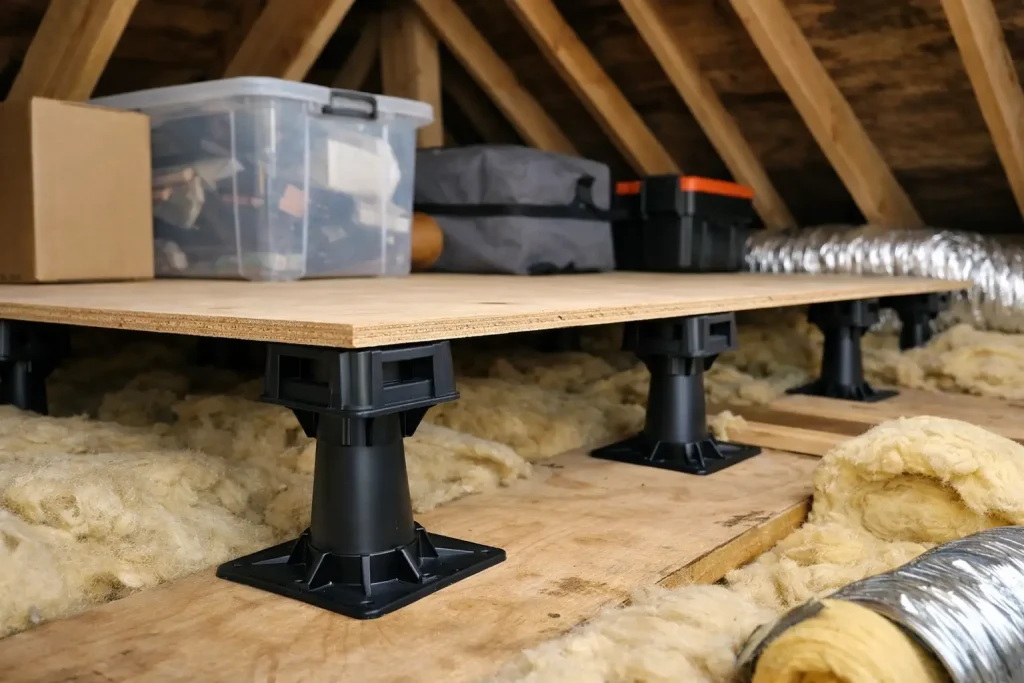
If your loft already has deep insulation, a raised loft legs review matters for one simple reason – boarding directly on top of that insulation can work against the very thing that keeps your home warm. Many homeowners only realise this after they have started using the loft for storage and noticed the floor feels uneven, the boards sit too low, or the insulation has been squashed flat underneath.
Raised loft legs are designed to create a gap between the ceiling joists and the loft boards above. That gap allows modern insulation to keep its depth and continue doing its job properly, while also giving you a more usable storage platform. On paper, it sounds like an obvious solution. In practice, whether they are right for your loft depends on the structure, the insulation depth, and what you actually want the space to do.
Raised loft legs review – what they actually solve
The biggest benefit of raised loft legs is that they address a common problem in newer and upgraded homes. Building standards have pushed insulation depths higher, which is good for energy efficiency but less convenient when you want boarded storage. Ceiling joists were not designed with thick insulation and storage flooring in mind at the same time.
Without a raised system, there is usually a compromise. Either the insulation gets compressed, reducing its thermal performance, or the boards cannot sit properly. Raised loft legs remove that compromise by lifting the deck above the insulation. For many households, that means proper storage without undermining heat retention.
That matters more than it might seem. Squashed insulation can contribute to heat loss, and heat loss means your home has to work harder to stay comfortable. If the loft is being boarded at all, it makes sense to do it in a way that protects the insulation rather than cancels out part of its benefit.
How raised loft legs perform in real homes
In everyday use, a good raised loft leg system does three jobs well. It keeps the loft boards level, it protects the insulation below, and it creates a stable platform for normal household storage. That includes boxes, suitcases, decorations, archived paperwork, and the many things people do not need every week but still want access to.
For most homeowners, that is the key point. Raised loft legs are not really about the plastic supports themselves. They are about whether the finished loft feels safe, tidy and practical. When installed correctly, the result is far better than balancing boards awkwardly across joists or trying to make use of a space that was never properly prepared.
There is also a long-term advantage. A correctly raised boarding system tends to age better because the load is distributed through the intended support points rather than improvised solutions. That helps the loft remain a reliable storage area rather than an area you use cautiously.
The strengths in any honest raised loft legs review
The clearest strength is insulation protection. That is the main reason raised loft legs have become so popular, especially in properties with 270mm of insulation or similar depths. If keeping your home energy efficient is part of the goal, this matters.
The second strength is access to storage without major disruption elsewhere in the home. A well-boarded loft can free up bedrooms, cupboards and landings. For families and long-term homeowners, that extra breathing room can make daily life feel more organised.
The third strength is compatibility with newer properties when the correct approved products are used. In homes still covered by NHBC warranty terms, this can be particularly important. Using NHBC approved loft legs for suitable installations helps protect both the insulation performance and the validity of the guarantee.
There is also the simple benefit of neatness. A professionally boarded loft using a raised support system tends to feel intentional and well finished. It is easier to use, easier to trust underfoot, and easier to keep orderly.
Where raised loft legs have limits
A balanced raised loft legs review should also be clear about what they do not do. They are not a cure for every loft issue. If the loft has poor access, inadequate lighting, damaged timbers, ventilation concerns, or insulation that needs replacing, those issues still need addressing properly.
Load expectations also matter. Raised loft legs are intended to support a boarded storage platform for normal domestic use, not turn a loft into a heavy-duty load-bearing area. There is an important difference between sensible storage and overloading the space. Good advice should always reflect that.
Loft shape can be another factor. Some lofts are straightforward and suit raised boarding very well. Others have awkward trusses, limited head height, pipework, cables or restricted access that reduce the amount of practical storage area available. In those cases, the system may still be worthwhile, but the usable result can be more modest than homeowners first imagine.
Price is another consideration. Raised loft legs cost more than simply laying boards badly across joists, but that is not really a fair comparison. The real comparison is between a loft boarded properly and one boarded in a way that risks reducing insulation performance or creating an unstable platform. Seen in that light, the extra cost is often justified.
Are raised loft legs worth it for older homes and newer homes?
It depends on the loft and the standard you want the finished result to meet.
In newer homes, raised loft legs often make strong sense because insulation depths are usually greater and warranty considerations may apply. A raised system is often the sensible way to gain storage while respecting how the home was designed to perform thermally.
In older homes, they can still be very worthwhile, particularly where insulation has been topped up over time. Many older lofts started with shallow insulation and later received extra layers. That improved energy efficiency, but it also made old-style boarding methods less suitable. Raised loft legs help bring those lofts up to a better standard for storage.
Where they may be less essential is in a loft with minimal insulation needs or very limited demand for storage. Even then, most homeowners prefer a solution that does not create future problems.
What separates a good installation from a poor one
The product matters, but the survey matters just as much. A good installation starts with an honest look at the loft itself – joist layout, insulation depth, ventilation, access, available boarding area and any restrictions already present.
Poor results usually happen when a one-size-fits-all approach is taken. If the loft legs are installed without considering the condition of the loft, the finished area may be awkward, undersized or not as useful as expected. Good workmanship means the system is fitted squarely, the boards are secure, and the loft remains safe and practical to use.
This is also where homeowners benefit from dealing with a specialist rather than somebody treating loft work as a sideline. At Loft Accessories, for example, we use NHBC approved loft legs in new homes where appropriate because doing the job properly means thinking beyond the boards themselves. The aim is always a storage area that works well, protects insulation and gives lasting value.
Who should consider raised loft legs?
They are a strong option for homeowners who want more storage but do not want to compromise the insulation already in place. They also suit households trying to keep the home tidier without filling spare rooms with boxes and seasonal items.
They are particularly useful if your loft already has thick insulation, your current boarding feels uneven or limited, or you want a safer and more reliable platform than the typical patchwork of loose boards. If your priority is preserving warmth in the home while still making the loft genuinely usable, raised loft legs are usually a sensible route.
If, however, your loft has wider issues with access or condition, those should be looked at as part of the overall plan rather than assuming raised legs alone will solve everything.
Final verdict on raised loft legs review
Raised loft legs are not a gimmick. For the right loft, they are a practical and well-proven way to create proper storage while protecting insulation performance. Their value comes from avoiding the false economy of boarding a loft in a way that reduces energy efficiency or leaves you with a platform you never fully trust.
The best results come when the loft is assessed properly, the right system is specified, and the installation is carried out with care. If your aim is straightforward – safe storage, easier access to belongings and no unnecessary compromise on heat retention – raised loft legs are often well worth considering. A loft should make life easier, not create another problem to put up with.