
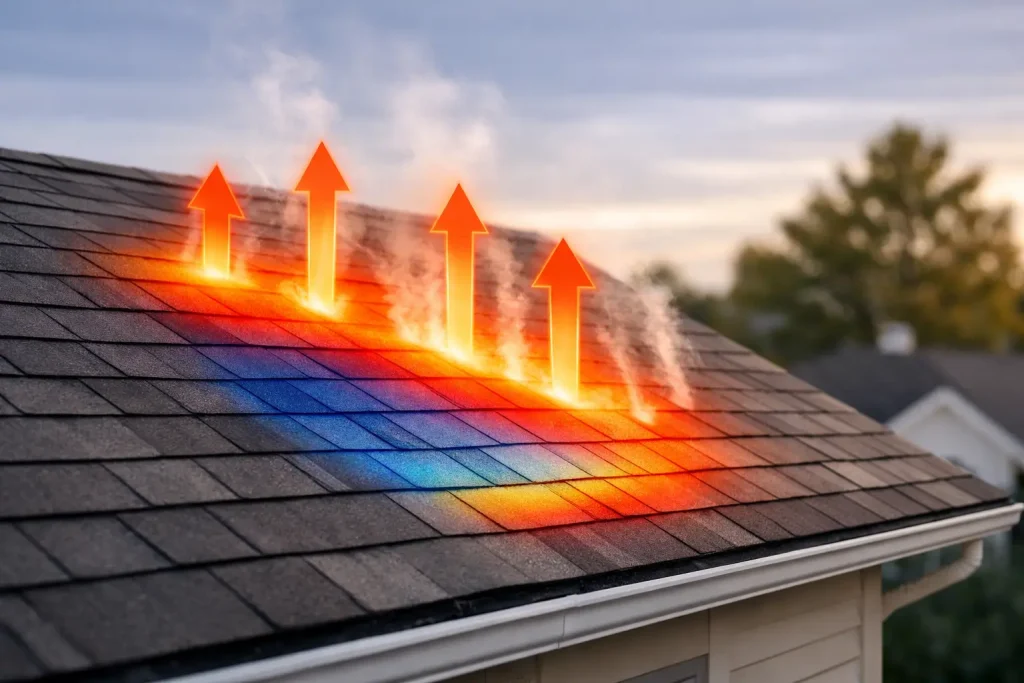
Stand in an upstairs bedroom on a cold evening and you can often feel the answer before you ever see a heating bill. When people ask how much heat is lost through the roof, they are usually trying to work out why the house never seems to stay warm for long – and whether sorting the loft will actually make a difference.
The short answer is yes, it often does. In an uninsulated home, a significant amount of heat can escape upwards through the roof. Warm air rises, and if there is little to stop it, that warmth leaves the living space below and disappears into the loft and out through the roof structure. In a well-insulated property, the percentage is much lower, but the roof still remains one of the most important areas to get right if you want a warmer, more efficient home.
How much heat is lost through the roof in a typical home?
You will often see figures suggesting that around 25% of a home’s heat is lost through the roof in an uninsulated property. That is a useful rule of thumb, but it is still only a guide. Real homes do not behave in exactly the same way, and heat loss depends on the age of the property, the type of roof, the condition of the insulation, and how air movement is managed across the loft.
A Victorian house with little or no loft insulation is a very different case from a modern estate home that already has some mineral wool laid between the joists. Even then, “some insulation” is not always enough. Older insulation may be too thin by current standards, patchy around the edges, or compressed under stored items and boarding. That means the roof area can still be responsible for a disappointing amount of energy loss, even when homeowners assume it has already been dealt with.
The key point is not whether your roof loses exactly 20%, 25% or 30%. It is whether your loft is allowing more heat to escape than it should. In many homes, the answer is yes.
Why so much heat rises through the roof
Heat naturally moves from warmer areas to colder ones. In winter, your heated rooms are warmer than the loft and the outside air, so heat is always trying to escape. Because warm air rises, the ceiling and loft floor become major pathways for that movement.
If insulation is missing, thin or disturbed, the transfer of heat happens much more quickly. Small gaps matter too. Around pipework, cables, loft hatches and awkward edges, even modest openings can reduce the overall performance of the insulation layer. This is one reason two homes with the same quoted insulation depth can still feel very different in practice.
Ventilation also plays a part, and this is where balance matters. A loft needs proper ventilation to control condensation, but ventilation should not be confused with allowing household heat to pour freely into the roof space. The aim is to keep the living area below warm while making sure the loft remains correctly ventilated and dry.
The biggest factors that affect roof heat loss
Insulation depth is usually the first issue. Many older properties still have insulation levels that fall well short of modern recommendations. Even if insulation was fitted years ago, standards have changed and energy prices have made underperformance more noticeable.
Condition matters just as much as depth. Insulation that has been squashed loses effectiveness. This is especially common where boards have been laid directly on top of the insulation for storage. It may look tidy, but compressed insulation cannot trap heat in the way it is designed to.
Coverage is another common problem. People are often surprised to find the centre of the loft insulated reasonably well while the eaves, corners and hatch area are left weak. Those thinner sections can have a real effect on comfort.
Then there is air leakage. A poorly fitted loft hatch, gaps around fittings, and penetrations for services can all allow warm air to escape from the rooms below. Heat loss is not only about what passes through materials. It is also about what slips through the spaces around them.
Insulation helps, but only if the loft still works properly
Homeowners often face a practical problem. They want better insulation to cut heat loss, but they also need the loft to remain useful for storage. That is where poor installations can create frustration.
If boards are fixed directly onto the joists over thick insulation, the insulation gets compressed. That reduces thermal performance and can leave people wondering why the loft looks neat but the house still feels cold. In newer properties, it can also raise concerns about following the correct installation approach.
A better solution is to create raised boarding above the insulation, so the material can keep its full depth and do its job properly. That way, the loft can be accessible and usable without sacrificing energy efficiency. For many households, that is the difference between a loft that becomes a dumping ground and one that genuinely adds practical value.
Signs your roof may be losing too much heat
Some clues are obvious, while others are easier to miss. If upstairs rooms cool down quickly after the heating goes off, the loft may not be performing as it should. If the house feels draughty around the ceiling line or the loft hatch, that can point to gaps and weak points in the thermal envelope.
High energy bills are another sign, although they are never caused by the roof alone. Windows, walls, floors and boiler efficiency all matter too. Still, the loft is one of the most straightforward areas to improve, particularly when compared with more disruptive measures elsewhere in the home.
You may also notice that stored items in the loft seem dusty, damp or exposed to strong temperature swings. That does not prove heat loss by itself, but it can suggest the space is not well balanced in terms of insulation, ventilation and access.
How much difference can better loft insulation make?
For many homes, a substantial one. Good loft insulation helps slow the movement of heat from the rooms below, so the home stays comfortable for longer and the heating system does not need to work as hard to maintain temperature.
That can mean lower energy bills, but the day-to-day benefit is often what people notice first. Bedrooms feel less chilly. The house warms up more evenly. The heating does not seem to vanish as quickly. These are practical improvements, not just technical ones.
It is worth saying that insulation is not a magic fix for every comfort issue. If there are major draughts, poor glazing or heating system problems, those may still need attention. But when a loft is under-insulated or badly boarded, improving it is often one of the most sensible steps a homeowner can take.
Why professional assessment matters
Lofts look simple until you get into the details. Joist height, insulation depth, ventilation paths, hatch access and safe storage all need to work together. A rushed or poorly thought-out job can leave homeowners with less performance, not more.
That is why a proper survey is so valuable. It shows what is already in place, where the weak spots are, and whether the loft can be improved without compromising insulation. In newer homes especially, using the right raised system matters if you want to protect both thermal performance and the property itself.
For homeowners in Milton Keynes and the surrounding areas, this is often where a specialist approach makes the difference. Loft Accessories focuses on making lofts safe, usable and energy efficient, with clear advice, written quotes and installations that are designed to work properly for the long term.
A sensible way to think about roof heat loss
If you are asking how much heat is lost through the roof, the most useful answer is not just a percentage. It is whether your loft is helping your home hold onto warmth or letting too much of it escape.
A well-insulated, properly boarded loft with safe access can do more than reduce wasted heat. It can make the house feel more comfortable, give you dependable storage space, and turn an overlooked part of the property into something genuinely useful. If your loft has not been checked for years, it may be worth looking at it with fresh eyes – because warmth lost through the roof is money spent heating the outside.