
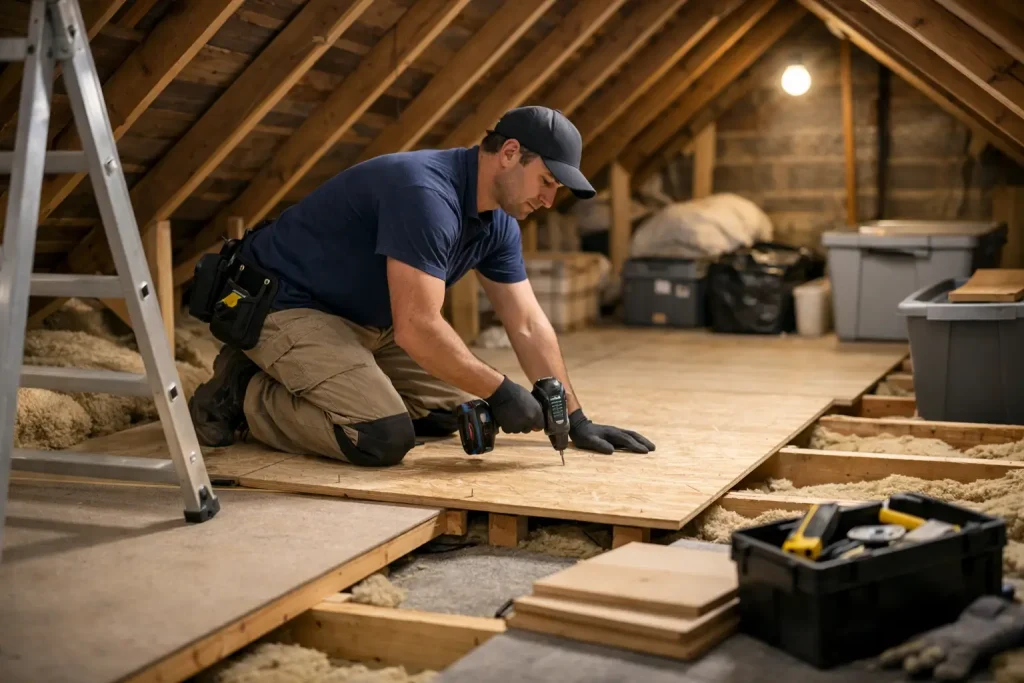
That awkward moment when you push the loft hatch open and remember why you avoid it – wobbling on joists, dodging insulation, and wondering where on earth the Christmas decorations are meant to go. A proper loft boarding for homeowners guide starts with one simple truth: the average loft has plenty of potential, but only when it is made safe, accessible and suitable for storage.
For many households, the loft becomes a wasted space because it feels inconvenient or risky to use. Yet with the right boarding, insulation setup and access, it can take pressure off bedrooms, cupboards and garages without changing the shape of your home. The key is getting the basics right so the space works well and does not create problems elsewhere.
What loft boarding actually does
Loft boarding creates a stable raised platform for storage above the ceiling joists. That sounds straightforward, but there is an important detail many homeowners miss. In most properties, especially newer ones, insulation needs to sit deep enough to do its job properly. If boards are fixed directly on top of the joists and squash the insulation underneath, thermal performance drops and the loft becomes less energy efficient.
That is why a boarded loft should never be thought of as just a few panels laid down for convenience. Done properly, it balances storage and insulation rather than forcing you to choose between them. You gain usable floor space while still helping the home retain heat, which matters more than ever when energy bills are high.
Loft boarding for homeowners guide: start with safety
The biggest mistake is assuming that if a loft exists, it is automatically ready for regular use. In reality, many lofts were never designed to hold day-to-day stored items across the whole area without a considered boarding system. The joists, insulation depth, pipework, wiring and water tanks all need to be taken into account.
Safe loft boarding means creating a clear designated storage area and protecting what sits below it. It also means making sure you can get in and out of the loft sensibly. If access is awkward, steep or poorly lit, even the best boarding becomes less useful. Homeowners often focus on the floor first, but the hatch and ladder matter just as much if you want the space to be genuinely practical.
Why raised boarding matters
Raised loft boarding is often the best option because it lifts the storage platform above the insulation instead of compressing it. This is particularly important in modern homes where warranty requirements need to be respected. In properties covered by NHBC standards, using an approved raised system helps preserve the intended insulation depth and can protect the validity of the 10-year guarantee.
There is a clear trade-off here. Raised boarding may cost more than a basic low-level approach, but it usually provides the right long-term result. You avoid undermining insulation performance just to gain storage, which would be a false economy for most households.
For homeowners who want to use the loft regularly, raised boarding also gives a neater, more dependable finish. Items sit level, the space feels better organised, and the risk of accidental damage to insulation is reduced.
Insulation and boarding should work together
A loft should help your home feel warmer, not become the place where heat quietly escapes. That is why insulation and boarding need to be planned together rather than treated as separate jobs.
If your loft insulation is old, patchy or below the recommended depth, boarding alone will not solve the bigger issue. In fact, adding storage without reviewing the insulation can lock in an underperforming setup for years. On the other hand, if insulation is topped up but left inaccessible, homeowners often stop using the loft altogether because they do not want to disturb it.
The best answer is usually a combined approach. Insulation is brought up to a suitable standard, then a raised boarded area is installed above it so the loft remains both energy efficient and useful. That gives you a practical storage area while supporting lower heat loss through the roof.
Access can make or break the whole job
A boarded loft with a narrow hatch or shaky ladder is only half-finished. Good access turns the loft from a once-a-year frustration into a part of the home you can use confidently.
A wider hatch can make a surprising difference, especially for families storing bulky but lightweight items such as suitcases, toys, decorations or archived paperwork. A proper loft ladder also gives far better footing than makeshift options and encourages safer, more frequent use.
Lighting is another detail that should not be overlooked. A dark loft invites missteps and makes it harder to find what you need. Even a well-boarded space feels unfinished if visibility is poor.
What can you store in a boarded loft?
This depends on the size of the boarded area, the structure of the loft and how the load has been planned. In most homes, a boarded loft is ideal for lighter household storage rather than heavy furniture or large concentrated loads.
Seasonal items, keepsakes, luggage, children’s items, spare bedding and boxes of household belongings are usually the sort of things homeowners have in mind. That is often enough to free up valuable room elsewhere in the house. If your goal is simply to reclaim a spare bedroom, hallway cupboard or airing cupboard, loft boarding can make a noticeable difference very quickly.
What matters is using the loft for the right kind of storage. Sensible loading protects both the boarding system and the ceiling structure below.
A loft boarding for homeowners guide to costs and value
Homeowners naturally ask about cost, and the honest answer is that it depends on the size of the area, the type of boarding system, insulation requirements, hatch alterations and ladder choice. A straightforward storage platform in one loft may be very different from a full package including raised boarding, upgraded insulation, a new hatch and improved access.
The better question is what value the work adds to everyday life. A tidy, accessible loft can remove clutter from the main living areas, make storage safer and support better thermal performance. For many households, that means less stress at home as well as a more efficient property.
There is also value in proper assessment before work begins. A clear written quote, a full survey and honest advice about what your loft can and cannot do are worth far more than guesswork. Good installers should explain the options plainly, not push a one-size-fits-all answer.
Why specialist installation matters
Lofts look simple until you account for the hidden details. Cable runs, ventilation, insulation depth, water pipe routes and the condition of the existing hatch all affect the final result. That is why specialist loft installers often spot issues that a general tradesperson might overlook.
For newer homes, this specialist approach becomes even more important. Using NHBC approved loft legs where appropriate is not just a technical preference. It is about protecting the home properly while creating a reliable storage area.
Homeowners also benefit from a cleaner, more predictable process. Friendly communication, insured work, punctual arrival and tidy completion all matter when tradespeople are working inside your home. The practical result matters, but so does the experience of getting there.
Signs your loft is ready for boarding
If your upstairs cupboards are overflowing, your garage is doing too many jobs, or your spare room has become a holding area for everything without a proper home, the loft is probably worth considering. The same applies if you know your insulation is due for attention or your current loft access puts you off using the space at all.
In many homes across Milton Keynes and surrounding areas, these are common problems rather than unusual ones. The good news is that they can often be solved without major disruption. A well-planned loft storage setup is one of the more practical improvements a homeowner can make because it addresses space, comfort and efficiency all at once.
Choosing the right approach for your home
No two lofts are exactly alike, and that is why the best advice is always based on the property in front of you. Some homes need a modest boarded section for occasional storage. Others benefit from a wider solution that includes insulation upgrades, better lighting, a new hatch and safer ladder access.
The right choice comes down to how you want to use the space, the age and layout of the home, and whether preserving insulation performance is a priority – which, in most cases, it should be. Reliable guidance should feel straightforward and honest, not overcomplicated.
If you are weighing up your options, look for a specialist who explains things clearly, provides a proper survey and gives recommendations that suit your loft rather than a standard package. A good loft should make home life easier, warmer and less cluttered. When it is done properly, that empty space above your ceiling starts earning its keep.