
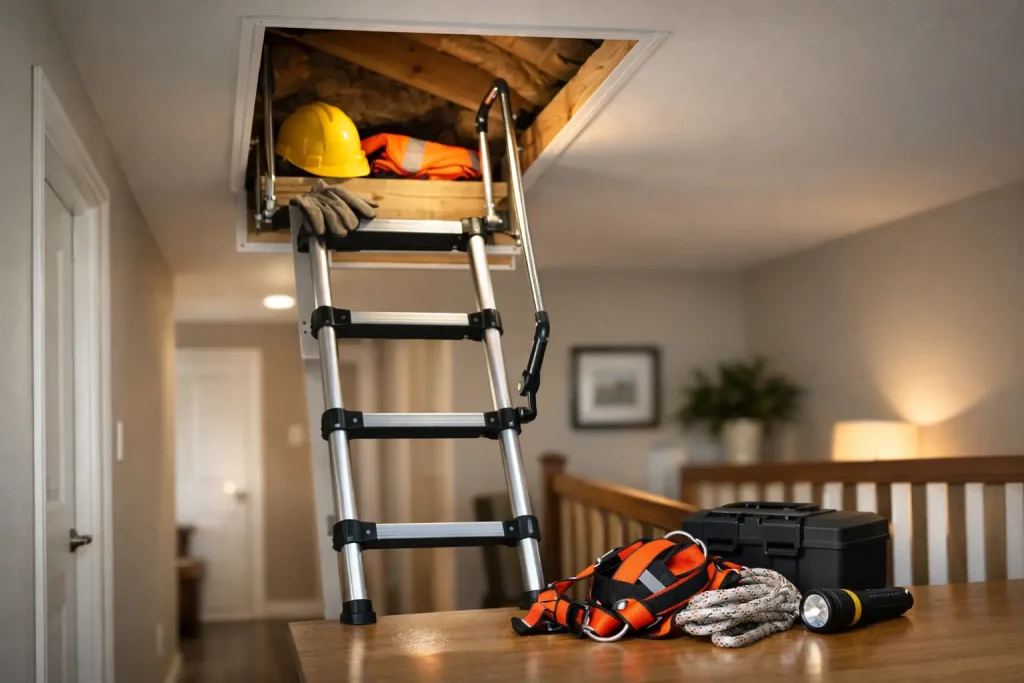
A loft only becomes useful when it is safe to reach. That is where a proper loft access safety guide matters. Many homeowners have plenty of space overhead, but if the hatch is awkward, the ladder feels unsteady, or the floor is unreliable, that storage quickly becomes more trouble than it is worth.
For most households, the issue is not the amount of loft space available. It is whether you can get up there safely, store things properly, and come back down without risk. A good loft setup should feel straightforward every time you use it, not like a balancing act with a torch in one hand and a box in the other.
Why loft access safety matters more than people think
Lofts are often treated as simple storage areas, but they are not designed for casual use unless the access has been planned properly. A small hatch, a steep ladder, poor lighting, and exposed insulation can all turn a quick trip into a hazard. The risk increases further when people start storing heavier items or making more regular use of the space.
There is also the wider issue of protecting the home itself. Unsafe loft access is not just about slips and falls. Poor boarding can compress insulation, reduce thermal performance, and lead to unnecessary heat loss. In newer homes, using the wrong system can even create problems with warranty requirements. Safety and efficiency usually go hand in hand.
Loft access safety guide – the key areas to get right
The safest lofts work as a complete system. It is rarely one feature alone that makes the difference. The hatch, ladder, boarding, insulation and lighting all need to support safe and practical use.
A safe loft hatch starts with size and placement
An old or undersized hatch can make even a decent loft difficult to access. If the opening is too tight, lifting boxes through it becomes awkward and puts strain on your back and shoulders. If it is badly positioned, the climb can feel cramped before you are even in the loft.
A well-fitted loft hatch should allow comfortable entry and exit without forcing you into an unsafe position. It should open cleanly, close securely and sit neatly within the ceiling. Where possible, a larger hatch often makes day-to-day use far easier, especially for families who want simple access to stored items through the year.
The ladder should feel stable, not makeshift
Loft ladders vary a great deal in quality and suitability. Some are adequate for occasional access, while others are designed for more regular use and provide a firmer, safer climb. What matters most is stability underfoot, a sensible angle, and a design that suits the available ceiling height and landing space below.
This is one of those areas where it depends on how you plan to use the loft. If access will be infrequent and only for light storage, one option may be perfectly suitable. If you expect to go up often with boxes, decorations or suitcases, a more substantial ladder usually makes better sense. The goal is confidence. You should not have to test each step or brace yourself every time you climb.
Lighting is not optional
A surprising number of lofts rely on a handheld light or whatever daylight filters through. That is not a safe arrangement. Proper loft lighting makes it easier to place your feet, find stored items quickly and avoid unnecessary strain.
Even a solid ladder and secure boarding can be undermined by poor visibility. Shadows around the hatch area are particularly risky, as that is where people are turning, stepping up or stepping down. Good lighting does not need to be complicated, but it does need to be reliable and positioned where it actually helps.
Boarding must support safe movement and protect insulation
One of the most common loft safety problems is assuming that the visible joists or a few loose boards are enough for storage. They are not a substitute for a properly raised and fitted boarding system. If the loft floor is not stable and clearly usable, every trip into the loft becomes uncertain.
This is especially relevant in modern homes, where insulation depth is greater than it used to be. If boards are laid directly over the insulation, that insulation gets compressed. Once compressed, it cannot perform as intended, which affects the home’s energy efficiency and can lead to higher heating costs.
Raised boarding systems solve this properly by creating a storage platform above the insulation rather than flattening it. In newer properties, NHBC approved loft legs are often the right approach, as they help preserve the insulation depth and protect the validity of the NHBC guarantee. That gives homeowners a safer walking surface without sacrificing thermal performance.
What makes a loft genuinely safe to use
A useful loft is not one you can technically reach. It is one you can use confidently, without second-guessing each movement. In practice, that means stable access, safe footing, clear visibility and sensible storage limits.
There is also a difference between safe access and overloading a loft. Even with proper boarding, a loft is usually intended for domestic storage rather than very heavy loads. Suitcases, seasonal decorations, archive boxes and similar household items are generally one thing. Very dense items stored in bulk are another. Safe use depends on what is being stored as well as how the loft has been fitted out.
Signs your current loft access may need attention
Many homeowners put up with poor loft access for years because they only use the space occasionally. That does not make it safe. If the hatch sticks, the ladder shifts, or you avoid going up there unless absolutely necessary, the setup is already telling you something.
Other warning signs include insulation that has been flattened by boards, exposed areas where there is no clear walkway, or a loft that feels too dark to move around comfortably. Some households also notice draughts around the hatch, which can point to poor fitting and lost heat.
If you are unsure, a professional survey is usually the simplest way to understand what is happening. An experienced loft specialist can assess the access, explain what is suitable for your property, and recommend a solution that fits how you actually use the space.
A practical loft access safety guide for newer homes
Newer properties often need more careful handling than people expect. The insulation standards are typically higher, which is good for efficiency, but it means there is less room for shortcuts. Boarding directly over insulation may seem convenient in the short term, but it can create longer-term problems with performance and warranty compliance.
This is where specialist installation matters. A system designed specifically for raised loft boarding, paired with the right hatch and ladder, keeps the space safe and usable while respecting the structure of the home. For homeowners in places such as Milton Keynes, where many properties are relatively modern, that detail is more than a nice extra. It is part of doing the job properly.
Why professional installation makes the difference
Loft access looks simple from below. In reality, getting it right means understanding ceiling openings, ladder fit, weight distribution, insulation depth and the practical flow of entering and leaving the space. A tidy finish matters too, because the hatch sits in a visible part of the home and should not look like an afterthought.
A professional approach also gives homeowners clearer reassurance. You know what is being fitted, why it is suitable, and what it will cost before work starts. That level of clarity is particularly important with lofts because the wrong setup can leave you with a space that still feels awkward or unsafe despite the expense.
At Loft Accessories, this is why the focus stays on straightforward advice, written quotes and specialist installation rather than one-size-fits-all recommendations. Every home is slightly different, and a reliable outcome usually comes from matching the access solution to the property, not forcing the property to fit the product.
Getting the balance right between storage, safety and energy efficiency
The best loft improvements do three jobs at once. They make the space easier to access, safer to use and more efficient for the home overall. If one of those is missing, the result tends to feel compromised.
For example, adding access without improving the floor can leave the loft easy to reach but still unsafe once you are inside. Boarding without protecting insulation can create storage at the expense of heat retention. A larger hatch without proper lighting still leaves unnecessary risk. The most effective setup is balanced from the start.
If your loft is currently difficult to access, rarely used, or simply not giving you the safe storage space it should, the answer is usually not more effort from you. It is a better system overhead, fitted properly, so using your loft feels simple, secure and worth having in the first place.