
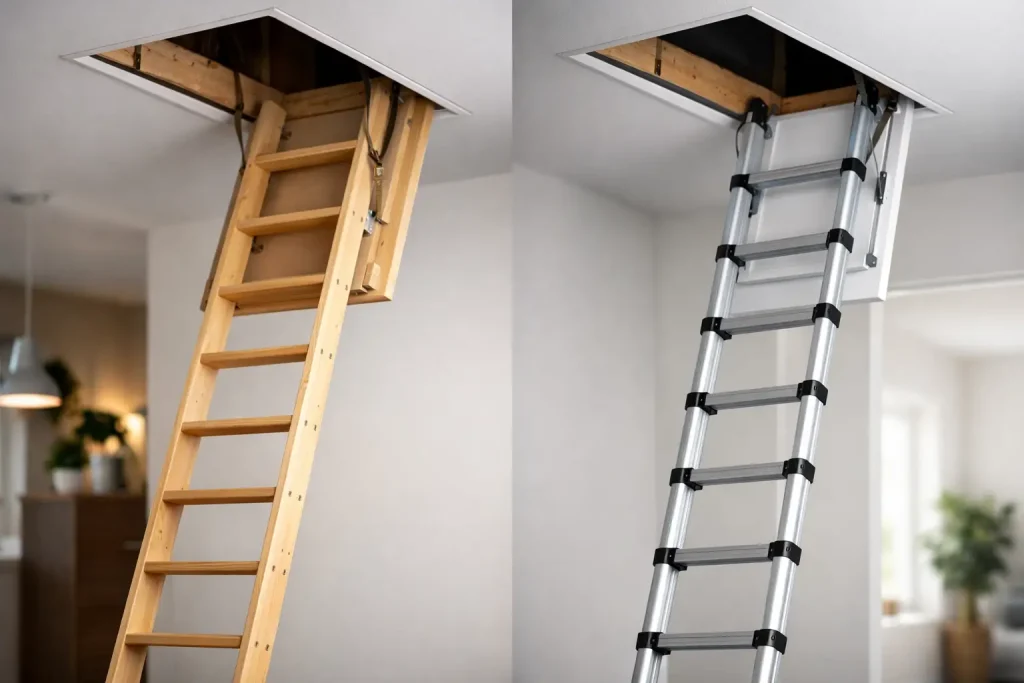
A loft can be ideal for keeping seasonal items, family keepsakes and the things that otherwise fill spare rooms. But if getting up there means balancing on a step ladder or squeezing through a small hatch, the space is unlikely to be used safely or often. When comparing wooden vs aluminium loft ladders, the right choice comes down to more than appearance. Your available space, hatch opening, insulation needs and how regularly you use the loft all matter.
Both types can provide safe, reliable access when correctly specified and professionally fitted. The best option is the one that works comfortably with your home, rather than simply the one with the lowest upfront price.
Wooden vs aluminium loft ladders: the main difference
Wooden loft ladders are normally folding units, often made from timber sections that unfold into a fixed stair-like ladder. They tend to feel solid underfoot and are a popular choice for homeowners who want regular, confident access to a boarded storage area.
Aluminium loft ladders are lighter and commonly available in sliding, folding or telescopic designs. They are practical where the loft hatch is smaller, the landing area is tight or a compact solution is needed. Their lighter construction can also make them easier to operate, particularly when access is occasional.
Neither material is automatically better. A well-chosen aluminium ladder can be an excellent long-term solution, while a wooden ladder may be unnecessary in a loft used only a few times a year. The important thing is matching the ladder to the property and the way your household will use the space.
Why wooden loft ladders suit regular storage access
A wooden loft ladder often feels closer to a small staircase than a traditional ladder. The treads are generally broader and more comfortable underfoot, which can make a noticeable difference when carrying storage boxes or bringing down Christmas decorations. Many homeowners also prefer the reassuring, substantial feel of timber.
Wooden ladders are usually fitted as a folding unit within or alongside a compatible hatch. They can offer a good incline and stable footing, particularly where there is enough room to open the sections fully. Handrails can be included where appropriate, giving added confidence for everyday access.
Another benefit is thermal performance. Timber itself does not conduct cold as readily as metal. However, the insulation quality of the hatch arrangement matters far more than the ladder material alone. If your loft is insulated to modern standards, a properly sealed, insulated loft hatch is essential to help prevent warm air escaping into the roof space.
There are practical limitations. Wooden ladders are heavier than most aluminium options and need enough clear landing space to unfold safely. They may not be suitable for every ceiling height or hatch position. Timber can also be affected by damp conditions, so a loft should be dry, well ventilated and free from ongoing roof issues before any access solution is installed.
For a family home with a properly boarded storage area and frequent loft use, a wooden ladder is often a very sensible investment. It provides a stable route in and out of the loft and makes the space feel more usable, not just technically accessible.
When an aluminium loft ladder makes more sense
Aluminium loft ladders are valued for their low weight, neat storage and flexibility. A sliding or telescopic model can be particularly useful where there is limited room beneath the hatch. Rather than needing several folding sections to swing down, some aluminium ladders extend in a more compact way.
This can suit homes with narrow hallways, restricted landing space or awkward hatch locations. Aluminium is also resistant to rust in normal household conditions and does not need painting or treating. For a loft used mainly for lighter, occasional storage, it can be a straightforward and dependable choice.
The trade-off is often comfort. Aluminium rungs are typically narrower than timber treads, and the ladder may feel steeper depending on the model and ceiling height. This does not make it unsafe when it has been properly installed, but it can make repeated trips less pleasant, especially while carrying bulky items.
Some homeowners are concerned that an aluminium ladder will make the house colder. Again, the main issue is not the ladder itself but the hatch. An uninsulated or poorly sealed hatch can allow heat loss regardless of whether the ladder is timber or aluminium. A good installation considers the ladder, hatch, draught sealing and insulation together.
Think about the hatch before choosing a ladder
The existing loft hatch is a key part of the decision. Many older homes have small openings that make safe access difficult, particularly if larger storage items need to be moved in and out. In some cases, enlarging the hatch provides more benefit than simply changing the ladder.
A suitable hatch should allow comfortable entry without forcing you to twist, stoop excessively or climb around the ladder mechanism. It should also close securely and sit neatly within the ceiling. Where insulation is being upgraded, the hatch should be brought up to a similar standard so that the improvement is not undermined by a weak point in the ceiling.
Ceiling height matters too. A ladder that is too short may sit at an unsafe angle, while one that is too long can be difficult to store or operate correctly. The clear floor space beneath the hatch must be measured, including door swings, radiators, furniture and the normal route through the room or landing.
This is why a home survey is worthwhile. It identifies the limitations of the space before work begins and avoids choosing a ladder that looks suitable on paper but does not work well in day-to-day use.
Safety is about the whole access route
A loft ladder should not be assessed in isolation. The route from the room below to the storage area above needs to be safe from start to finish. That includes a stable ladder, a well-supported hatch, secure fixings, suitable handrails where needed and a clear area around the opening.
Inside the loft, there should be a safe place to step off the ladder. If loft boarding is being installed, it should provide a firm storage platform without compressing insulation beneath it. In newer homes, raised boarding systems using NHBC approved loft legs can protect the insulation depth and help maintain the conditions required by the property’s warranty.
It is also worth considering what will be stored. Heavy boxes, large suitcases and awkward items should not be routinely carried up a ladder that is too steep or narrow for the task. A more substantial wooden ladder may be the safer choice where access is frequent and loads are heavier. For light, occasional storage, aluminium can be entirely appropriate.
Cost, lifespan and value for your home
Aluminium ladders are often less expensive to buy and can be quicker to accommodate in compact spaces. Wooden ladders can cost more because of their heavier construction and the space they require, but they may offer better comfort and confidence for regular use.
The cheapest option is not always the best value. A ladder that is awkward to operate soon turns a useful loft back into wasted space. Equally, there is little reason to pay for a large timber ladder if the loft is only used for a few lightweight boxes once or twice a year.
Professional fitting also protects the value of the installation. The ladder needs to be securely fixed to suitable structural timbers, adjusted for the correct angle and tested for smooth, safe operation. A tidy finish around the hatch helps the work look right in the home, while an insulated and draught-sealed hatch supports the wider aim of reducing heat loss.
Choosing the right ladder for your household
Choose a wooden loft ladder if you want frequent, comfortable access to a well-organised storage area and have enough room for a folding design. It is often the stronger choice for busy family homes, particularly where a stable, stair-like feel is valued.
Choose an aluminium loft ladder if space below the hatch is limited, access will be occasional or a lighter, more compact mechanism suits the layout better. It can be a practical answer in many homes, provided the ladder is the right length and the hatch is properly insulated.
For homeowners across Milton Keynes and the surrounding area, Loft Accessories can assess the hatch, ceiling height, loft layout and insulation before recommending a suitable option. Clear advice at this stage helps ensure the ladder fits the home, the storage plan and the way you actually live.
A good loft ladder should make an overlooked part of the house feel simple to use. When access is safe, the hatch is well insulated and the storage area is properly prepared, you can put the loft to work without making everyday life harder.