
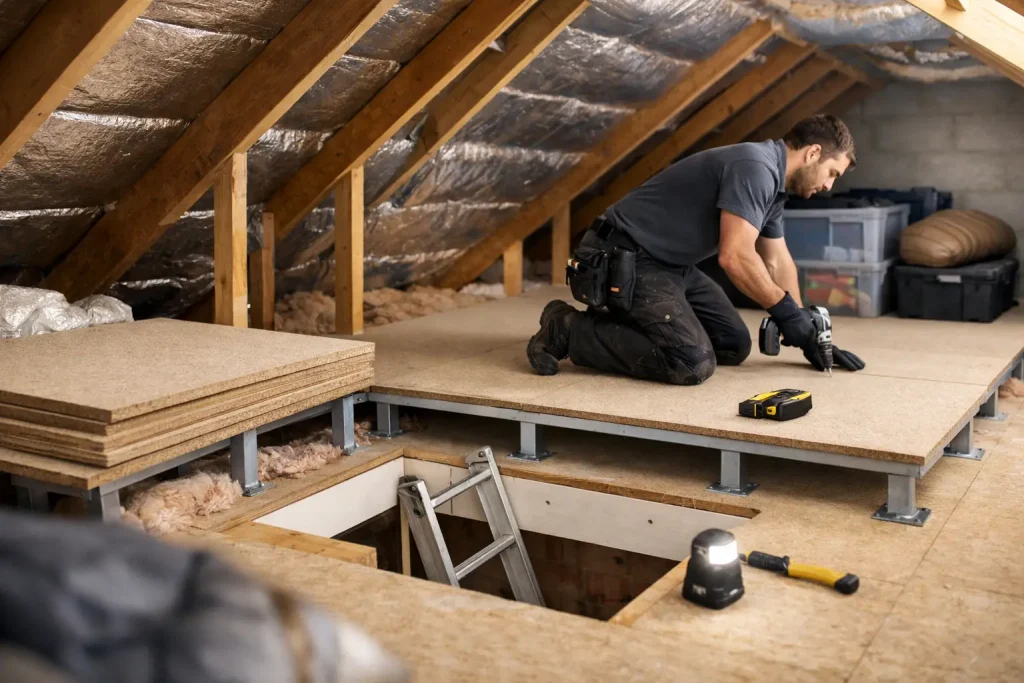
If your loft is full of awkward corners, exposed joists and insulation that looks too soft to stand on, the problem usually is not a lack of space. It is a lack of usable space. That is where raised loft boarding installation makes such a difference. Done properly, it creates a solid storage platform above the insulation, so you can make practical use of the loft without reducing the thermal performance of your home.
For many homeowners, that balance is the key point. You want somewhere safe to store seasonal items, suitcases and family keepsakes, but you do not want to damage insulation or create problems later. A boarded loft should make life easier, not undo the energy-saving work already in place.
What raised loft boarding installation actually does
Standard loft insulation is designed to sit thickly between and above the ceiling joists. That is good news for heat retention, but it creates a challenge when you want storage. If boards are fitted directly onto the joists, the insulation underneath gets compressed. Once insulation is squashed, it cannot perform as intended, which can lead to greater heat loss and higher heating costs.
Raised loft boarding installation solves that by lifting the boarding above the insulation. A support system is fitted first, then the boarding is fixed on top to create a firm decked area. The insulation is left with the depth it needs, and the loft becomes far more practical to use.
This approach is especially relevant in modern homes, where insulation levels are often deeper and new-build warranty requirements need careful consideration. In those cases, using the right approved system matters just as much as the boarding itself.
Why raising the boards matters more than many people realise
A loft can look tidy enough once boards are down, but appearance is only part of the story. What sits underneath makes the real difference to performance and long-term value.
When loft insulation is compressed, warm air escapes more easily through the ceiling below. You may not notice it in one dramatic moment, but over time it can affect comfort and energy bills. Raised boarding helps avoid that trade-off. It gives you storage without sacrificing the insulation depth that helps keep rooms warmer in winter and more stable throughout the year.
There is also a safety aspect. An unboarded loft or a partly boarded one can be awkward to navigate. People end up balancing on joists, stepping around insulation and reaching over uneven surfaces to move boxes. A professionally installed raised platform creates a defined area for walking and storage, which makes the space more reliable and far easier to use.
Raised loft boarding installation in newer homes
New-build properties often need a little more care. The loft structure may be perfectly suitable for storage, but the method of installation must respect the standards the property was built to. That includes protecting the insulation and, where relevant, maintaining the validity of the NHBC guarantee.
This is why specialist systems such as NHBC approved loft legs are commonly used in suitable new homes. They raise the boards above the insulation rather than pressing down into it. For homeowners, that means the loft can still become a useful storage area without compromising an important part of the property documentation.
It is one of those details that can be missed if the work is treated as a simple boarding job. In reality, it needs a specialist eye. The right recommendation depends on the age of the property, the insulation depth and how the loft is constructed.
What to expect from the installation process
A proper raised loft boarding installation starts with a survey, not a guess. The loft needs to be checked for insulation levels, access, joist condition, head height and the most sensible area to board. Not every loft should be boarded wall to wall, and honest advice matters here. In some homes, a partial boarded area is the most practical choice because it gives useful storage while keeping the layout sensible and safe.
Once the layout is agreed, the raised support system is fitted across the chosen area. Boarding is then fixed securely to create a stable surface. If the loft insulation needs topping up first, that should be dealt with before the deck goes down. It is usually more cost-effective and logical to get the insulation right at the same time rather than revisit the space later.
Many homeowners also choose to improve loft access during the same project. A raised boarded area is far more useful when paired with a safe loft ladder and a properly sized hatch. These elements work together. There is little benefit in creating neat storage if getting in and out of the loft remains awkward.
The benefits go beyond storage
The obvious benefit is decluttering the house below. Bedrooms, airing cupboards and spare rooms often end up carrying items that do not need to be on hand every day. A well-planned loft storage area gives those belongings a proper home.
But there are wider benefits too. Preserving insulation depth can help reduce unnecessary heat loss, which supports lower running costs. Better organisation also means less chance of boxes being stacked precariously in the wrong places. And when access is improved, the loft becomes a space you can use confidently rather than avoid.
For long-term homeowners, there is value in doing the work properly once. A professionally installed system is neater, sturdier and better suited to the property than a piecemeal approach. It also gives peace of mind that the work has been carried out with safety, insurance and proper materials in mind.
Is every loft suitable?
Not always, and this is where straightforward advice matters most. Some lofts have limited headroom. Others have layouts that restrict how much boarding makes sense. Water tanks, pipework, cables or very shallow access points can all affect the final design.
That does not necessarily mean the loft cannot be improved. It may simply mean the solution needs to be tailored. Sometimes the best result is a smaller raised storage platform with a clear walkway. In other cases, upgrading insulation and access first makes the space much more practical afterwards.
A good specialist will explain those options clearly, along with any limitations. Homeowners do not need a sales pitch. They need to know what will work, what will not, and where their money is best spent.
Why specialist installation makes the difference
Raised loft boarding looks straightforward from the outside, but getting it right means understanding insulation performance, safe load-bearing areas, access requirements and property-specific constraints. General building knowledge is not always enough. Loft spaces have their own rules, and small mistakes can have long-lasting effects.
That is why many homeowners prefer to use a company that focuses specifically on lofts rather than treating the work as an add-on service. A specialist is more likely to spot issues early, recommend the right boarding system and complete the work cleanly and efficiently.
For families and busy households, that reliability matters. People want clear written quotes, punctual appointments and a tidy finish. They want to know the loft will be left safer, easier to access and genuinely useful. In Milton Keynes and surrounding areas, that practical, no-fuss approach is often what turns a neglected loft into one of the most valuable storage spaces in the house.
Choosing a raised loft boarding installation that lasts
The best installations are not always the biggest. They are the ones designed around how the household actually lives. If you need space for Christmas decorations, luggage, archived paperwork and a few sentimental boxes, the loft should be laid out to suit that purpose. There is no point paying for more boarding than you will use, and no benefit in fitting boards in a way that reduces insulation performance.
Quality materials, proper supports and accurate fitting all matter, but so does honest planning. A good result should feel simple once complete. You should be able to open the hatch, climb up safely and store items without worrying where to stand.
That is really the value of raised loft boarding installation. It turns wasted overhead space into something practical while helping your home stay efficient, organised and easier to live in. If your loft has been off limits or underused for years, the right solution can make it feel like part of the house at last.
A loft does not need to be complicated to be useful. It just needs to be done properly, with the right advice from the start.