
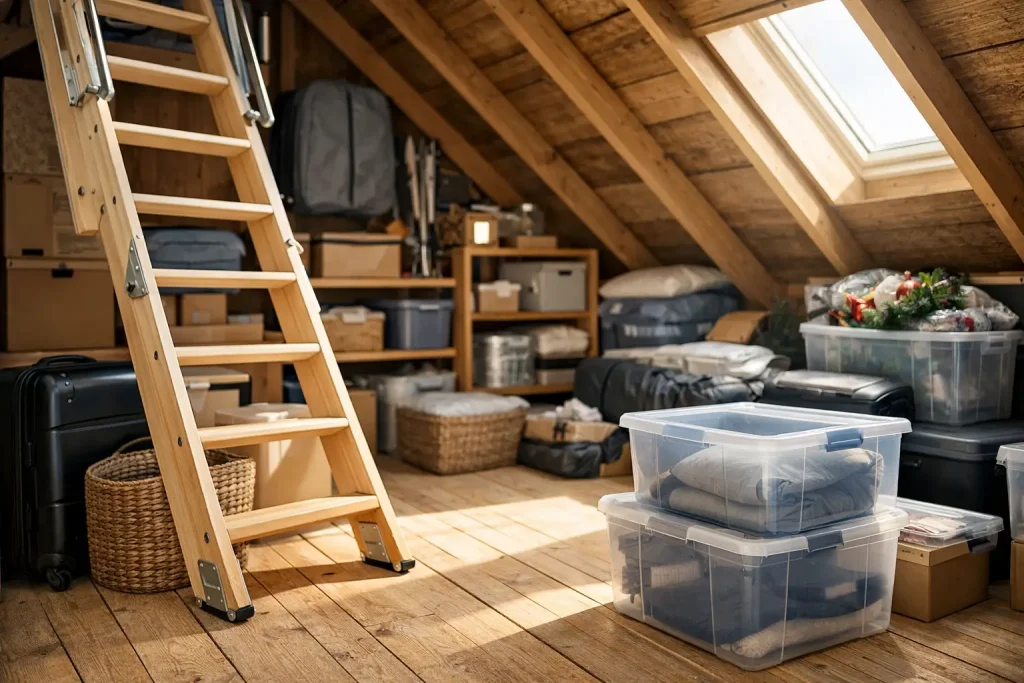
Christmas decorations in July. Suitcases balanced on top of wardrobes. Boxes of keepsakes shoved into the spare room because the loft feels awkward, chilly or simply unsafe to use. For many homeowners, the real issue is not a lack of space but not knowing how to use loft space for storage in a way that is practical, safe and worth the investment.
A good loft storage setup should do three things well. It should give you reliable room for the items you do not need every day, it should be easy to access without hassle, and it should protect your home’s insulation rather than working against it. Get that balance right, and your loft becomes one of the most useful parts of the house.
How to use loft space for storage without causing problems
The biggest mistake people make is treating the loft as an empty void and assuming any boarded surface will do. In reality, your loft sits right above the warm part of your home, so whatever happens up there affects energy efficiency, safety and even the condition of the house over time.
If insulation is squashed under boards, it cannot perform properly. If access is poor, the space tends to become a place where boxes are dumped rather than organised. If the boarding is not suited to the structure, you can end up with an uneven, impractical area that never feels fully secure.
That is why the best approach starts with the loft itself. Before thinking about what you want to store, it helps to look at what the space can realistically support and how often you will use it. A loft used for occasional seasonal storage needs a different setup from one used weekly for family overflow, archived paperwork or household essentials.
Start with safe, raised loft boarding
If you want to use your loft properly, the floor matters more than anything else. Insulation in modern homes is much deeper than it used to be, which is good for heat retention but creates a problem for storage. Standard boarding laid directly over joists can compress that insulation, reducing its effectiveness and increasing heat loss.
Raised loft boarding solves that issue by lifting the platform above the insulation. This allows the insulation to keep doing its job while still giving you a stable area for storage. In newer properties, this matters even more, because using NHBC approved loft legs helps protect the 10-year warranty while creating a usable storage deck above the insulation layer.
This is one of those areas where cutting corners tends to cost more later. A properly installed boarded area gives you confidence when carrying boxes, reduces the chance of damage to insulation and makes the space far more pleasant to use. It also creates a clear storage zone rather than a patchy, awkward surface.
Think about access before you think about boxes
A loft can have all the boarding in the world, but if getting into it feels like hard work, it will not be used properly. Access is often the difference between valuable storage and wasted space.
A secure loft ladder and a well-fitted hatch make the loft easier and safer to reach. This is especially important for busy households where storage needs to be practical, not theoretical. If you have to wrestle with an unreliable hatch or balance on an unsuitable ladder, you are less likely to use the loft regularly and more likely to leave things cluttering the main living areas.
There is also a comfort factor that homeowners often overlook. Better access means less strain, fewer awkward lifts and a much tidier experience overall. If the route in and out feels stable and straightforward, the loft becomes part of your home storage system rather than a last resort.
Decide what belongs in the loft
Not everything should live in a loft. The best use of the space is for dry, non-essential items that do not need frequent access. Holiday decorations, suitcases, archived documents, baby items kept for later, and neatly packed keepsakes are all common examples.
Items that are sensitive to temperature extremes are usually less suitable. Depending on the property, lofts can become very warm in summer and cold in winter. That means certain materials, electronics or delicate belongings may be better stored elsewhere. The right answer depends on the conditions in your home, but it is always worth thinking about how the loft environment will affect what you store there.
A sensible rule is to use the loft for belongings you want to keep but do not need close at hand. That frees up bedrooms, cupboards and garages for day-to-day living. For families, this can make a noticeable difference to how calm and organised the house feels.
Use zones to make the space work harder
One of the simplest ways to improve loft storage is to stop thinking of it as one large dumping area. A better approach is to divide the boarded space into zones based on how often items are used.
Keep the most frequently needed boxes closest to the hatch. Seasonal items can sit just beyond that. Long-term storage can go further back, provided the boarded area allows safe access. This small change saves time and prevents the common problem of moving half the loft just to find one box.
Clear containers or well-labelled boxes help as well, but the real gain comes from layout. A loft that has a sense of order is easier to maintain. When each group of items has an obvious place, clutter is less likely to creep back into the rest of the home.
Insulation still matters when storage is the goal
Many homeowners first think about loft improvements because they need more storage, then realise the insulation needs attention too. That is often a very worthwhile combination.
If your loft insulation is outdated, patchy or underperforming, upgrading it alongside storage work can improve comfort in the house below and help reduce heat loss. That can translate into lower energy bills over time, which makes loft work more than just a decluttering exercise.
There is a balance to strike here. More insulation is generally helpful, but it needs to be installed in a way that still allows practical boarding and ventilation where required. That is where specialist advice matters. A good setup should support both thermal performance and usable storage rather than forcing you to choose one or the other.
How to use loft space for storage in newer homes
New-build and newer homes often come with stricter requirements, especially around insulation depth and warranty considerations. That does not mean loft storage is off the table. It simply means the system needs to be designed properly.
In these properties, raised boarding is usually the right route because it keeps the storage platform above the insulation rather than flattening it. Using the correct approved components is important, not only for performance but also for protecting the home’s warranty position.
This is one reason specialist loft companies are often a better fit than more general trades. The details matter. A storage solution that looks fine at first glance can still create issues if it ignores insulation depth, safe loading or access requirements.
A tidy loft should stay tidy
The most successful loft storage projects are the ones that stay easy to use. That means leaving enough room to move safely, avoiding overcrowding and resisting the temptation to fill every inch simply because it is available.
A loft works best when it feels manageable. If boxes are stacked too high or walkways become narrow, the space quickly becomes frustrating. It is often better to create a clearly usable storage area than to chase the maximum possible capacity at the expense of practicality.
For homeowners planning ahead, it is worth thinking about future use as well. Families grow, storage needs change and homes collect more belongings over time. A clean, professionally finished loft space gives you flexibility, which is often more valuable than cramming in a few extra boxes on day one.
When professional installation makes the difference
Loft storage sounds simple until you consider all the parts that need to work together – boarding, insulation, hatch access, ladders and the structure of the loft itself. If one part is wrong, the whole setup can feel compromised.
Professional installation brings clarity to that process. Instead of guessing what will fit or what the loft can safely accommodate, you get a solution based on the home you actually have. That means honest advice, a written quote, and a finished space that is stable, tidy and built for long-term use.
For homeowners in Milton Keynes and nearby areas, that local specialist approach can be especially useful in newer estates and modern developments where insulation standards and access needs vary from house to house. A straightforward survey often reveals options that are far more practical than expected.
Using your loft well is rarely about squeezing in more stuff for the sake of it. It is about making the house work better, with safer access, lower clutter and storage that feels like part of the home rather than an afterthought. Done properly, the loft becomes one of the quietest improvements you can make – the kind you notice every time the landing cupboard stays empty and the spare room stays clear.